What is a major scale?
A major scale is a seven-note scale built from a specific order of whole steps and half steps.
The simplest example is C major:
C D E F G A B CThere are eight written notes here, but only seven different note names. The final C repeats the first C higher, in the next octave.
The major scale is often associated with a bright or stable sound. That is a useful first association, but it is not a rule. The mood of music depends not only on the scale, but also on tempo, rhythm, chords, register, tone, and context.
The most important thing about the major scale is not that it is “happy”. The important thing is how it is built.
The major scale formula
The major scale is built with this formula:
whole step — whole step — half step — whole step — whole step — whole step — half stepA shorter version looks like this:
W — W — H — W — W — W — HWhere:
Wmeans whole step;Hmeans half step.
On guitar, a half step is one fret. A whole step is two frets.
If you start from C and follow this formula, you get C major:
| Step | Distance | Note |
|---|---|---|
| start | — | C |
| 1 | whole step | D |
| 2 | whole step | E |
| 3 | half step | F |
| 4 | whole step | G |
| 5 | whole step | A |
| 6 | whole step | B |
| 7 | half step | C |
Why C major has no sharps or flats
C major is a convenient first example because it has no sharps or flats:
C D E F G A B CBut this does not mean that every major scale is built only from “white keys” or simple natural notes.
For example, G major has F#:
G A B C D E F# GF# is not there to make the scale harder. It appears because the major scale formula must stay the same.
Check it:
G — A   whole step
A — B   whole step
B — C   half step
C — D   whole step
D — E   whole step
E — F#  whole step
F# — G  half step
Without F#, the formula would break: E to F is a half step, but the formula needs a whole step there.
How to build a major scale from any note
To build a major scale, do not guess the notes. Follow the formula.
The process is simple:
- Choose a starting note.
- Treat it as the first scale degree.
- Move through the formula
W — W — H — W — W — W — H. - Write down each note you get.
- Check that the final note matches the first note, but higher.
For example, let’s build G major:
| Scale degree | Note | How we got there |
|---|---|---|
| 1 | G | start |
| 2 | A | whole step from G |
| 3 | B | whole step from A |
| 4 | C | half step from B |
| 5 | D | whole step from C |
| 6 | E | whole step from D |
| 7 | F# | whole step from E |
| 1 | G | half step from F# |
So we get:
G A B C D E F# GThe major scale and scale degrees
The notes of a major scale can be counted as scale degrees.
In C major, it looks like this:
| Scale degree | Note |
|---|---|
| 1 | C |
| 2 | D |
| 3 | E |
| 4 | F |
| 5 | G |
| 6 | A |
| 7 | B |
| 1 | C |
Scale degrees matter because they show not only the order of the notes, but also their roles.
The first degree is the center of the scale. The third degree helps you hear the major character. The fifth often sounds stable. The seventh often wants to move back to the first.
So you can understand the major scale in two layers:
notes:         C D E F G A B C
scale degrees: 1 2 3 4 5 6 7 1
This is explained in more detail in “What Is a Scale Degree?”.
The major scale on one string
On guitar, one of the easiest ways to see the major scale formula is to play it on one string.
If you start from C on the fifth string, third fret, you get:
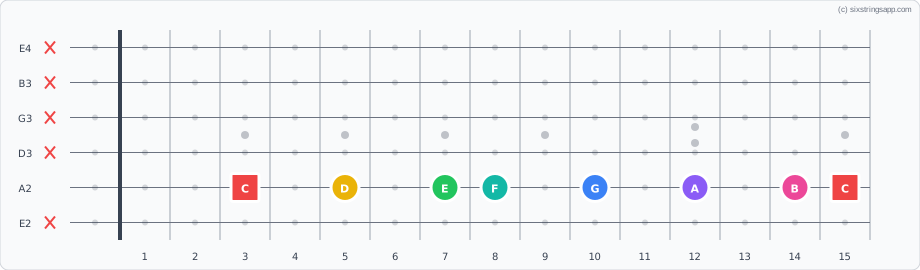
The fret distances show the formula:
+2 +2 +1 +2 +2 +2 +1These are the same whole steps and half steps:
W — W — H — W — W — W — HThis approach is useful because it shows the formula itself, without relying on a ready-made fingering shape.
The major scale on the fretboard
In real playing, you will rarely play a major scale only on one string. More often, you will spread it across several strings or across the whole fretboard.
For example, C major can be played in one position, across neighboring strings, or across the entire neck.
The important thing is not to get stuck in finger movement only. A fingering helps you play comfortably, but it does not replace understanding.
It is better to connect three things at once:
- the notes of the scale;
- the scale degrees;
- where those sounds are located on the fretboard.
To check this in practice, open Fretboard Explorer, choose C major, and switch between notes and scale degrees. First find all C notes, then E and G. This will show you the center and the notes of the major triad inside the scale.
How the major scale is connected to chords
Chords can be built from the notes of the major scale.
If you take C major:
C D E F G A Band build triads using only these notes, you get the chords of the key of C major:
| Scale degree | Chord |
|---|---|
| I | C |
| ii | Dm |
| iii | Em |
| IV | F |
| V | G |
| vi | Am |
| vii° | Bdim |
You do not need to memorize all chord-building rules yet. The main idea is enough: the major scale gives you the material for melodies and chords inside a key.
This will become more important in topics about keys, diatonic chords, and chord functions.
Why guitarists should understand the major scale formula
The major scale formula helps you avoid depending on one memorized shape.
With it, you can:
- build a major scale from any note;
- understand why some keys have sharps or flats;
- move a phrase into another key;
- see the connection between scales and chords;
- navigate the fretboard more clearly;
- understand where chord and scale formulas come from.
If you only know a fingering, the scale remains a finger pattern. If you understand the formula, the scale becomes a system.
How to practice the major scale
Do not start with speed. Start with the formula.
Try this:
- Find C on the fifth string, third fret.
- Play C major on one string: 3, 5, 7, 8, 10, 12, 14, 15.
- Say the distances out loud: whole step, whole step, half step, whole step, whole step, whole step, half step.
- Play the same notes backward.
- Then play only the 1st, 3rd, and 5th degrees: C, E, G.
- Return to C and listen to the feeling of center.
The goal is to connect the formula, the sound, and the movement on the fretboard.
5-minute exercise
- Write down the major scale formula:
W — W — H — W — W — W — H. - Build C major: C, D, E, F, G, A, B, C.
- Play it on one string, for example on the second string starting from C on the first fret.
- Build G major using the same formula.
- Find why G major needs F#.
- Play G major slowly.
- Compare the feeling of C as the first degree in C major and G as the first degree in G major.
- Try building a major scale from another note, such as D or E, and find its notes using the formula.
The goal is to understand that the major scale keeps the same formula even when it starts from a different note.
Common confusion
- The major scale is not just the white keys. C major has no sharps or flats, but other major scales can have them.
- Major does not always mean “happy”. The major scale has a specific structure, but the mood of music depends on many factors.
- The formula matters more than a ready-made fingering. A fingering shows a convenient way to play the scale. The formula explains why the scale is built that way.
- The seventh note does not always sound settled. In major, the seventh degree often wants to move back to the first.
- You do not need to learn every major key at once. It is better to build 2 or 3 scales with your hands and ears than to memorize a table mechanically.
What to learn next
After this topic, these articles are a good next step:
In short
The major scale is built with this formula:
whole step — whole step — half step — whole step — whole step — whole step — half stepThis formula stays the same in every major key. The starting note changes, and sharps or flats may appear, but the order of distances stays the same.
When you understand the major scale formula, it becomes easier to build scales from different notes, see scale degrees on the fretboard, and understand how scales, chords, and keys are connected.