What is a scale degree?
A scale degree is the position of a note inside a scale.
If a scale is an ordered set of sounds, scale degrees show which note you are taking from the beginning of that scale.
For example, the C major scale has these notes:
C D E F G A B CYou can count them as scale degrees:
1 2 3 4 5 6 7 1C is the first degree. D is the second. E is the third. The final C is counted as the first degree again, but in the next octave.
Scale degrees help you talk not only about note names, but also about the role each note has inside the scale.
Why scale degrees are more than simple counting
At first, a scale degree looks like just a note number. But in music, that number is often more useful than the note name itself.
Take two major scales:
| Scale degree | C major | G major |
|---|---|---|
| 1 | C | G |
| 2 | D | A |
| 3 | E | B |
| 4 | F | C |
| 5 | G | D |
| 6 | A | E |
| 7 | B | F# |
| 1 | C | G |
The notes are different, but the scale-degree logic is the same. The first degree is the center. The third helps you hear the major or minor character. The fifth often feels stable. The seventh often wants to move back to the first.
That is why musicians often think not only in note names, but also in scale degrees. It makes it easier to move melodies, riffs, and chords into other keys.
Tonic: the first degree and the center of the scale
The first scale degree is called the tonic.
The tonic is the main sound of the scale. It often feels like a resting point: a note you can land on at the end of a phrase.
In C major, the tonic is C.
C D E F G A B C
1 2 3 4 5 6 7 1
In G major, the tonic is G.
G A B C D E F# G
1 2 3 4 5 6 7  1
The name of the first note changes, but its role stays the same: it is the center the scale is built around.
Scale degrees in C major
In C major, the scale degrees look like this:
| Scale degree | Note | Simple feeling |
|---|---|---|
| 1 | C | center, support |
| 2 | D | movement away from the center |
| 3 | E | major character |
| 4 | F | light tension |
| 5 | G | strong support |
| 6 | A | soft continuation |
| 7 | B | pull toward C |
| 1 | C | return home |
These are not strict rules for every musical situation. Scale degrees can feel different in different styles, melodies, and harmonic contexts. But as a first map, this helps you hear that notes inside a scale do not all feel the same.
Why guitarists need scale degrees
Scale degrees help connect the fretboard, your ear, and music theory.
They make it easier to:
- understand scale formulas;
- move phrases into another key;
- see where the tonic is;
- build simple chords;
- understand why some notes sound stable while others create motion;
- learn scales not only as fingerings, but as a set of musical roles.
For example, a major triad is built from the 1st, 3rd, and 5th degrees. In C major, that gives you C, E, and G. In G major, it gives you G, B, and D. The note names change, but the formula stays the same:
1 — 3 — 5This is one of the main reasons to learn scale degrees: they show musical logic that stays the same across different keys.
How scale degrees look on the fretboard
On guitar, the same scale degree can appear in several places.
For example, in C major, every C note is the first degree. Every E note is the third degree. Every G note is the fifth degree.
If you look only at note names, the fretboard may feel like a set of separate dots. When you add scale degrees, a structure appears: you can see the center, the stable sounds, and the notes that create motion.
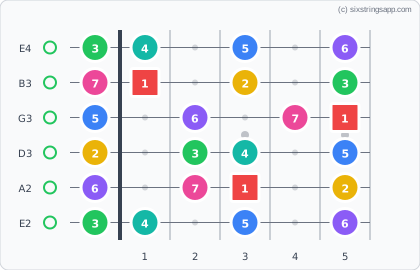
To check this in practice, open Fretboard Explorer, choose C major, and turn on scale-degree display. First find all the first degrees, then the thirds and fifths. After that, try playing a short phrase that ends on the first degree.
Scale degree vs note name: what is the difference?
A note name tells you which sound you are playing: C, D, E, F, and so on.
A scale degree tells you what role that sound has inside the chosen scale.
The same note can be a different scale degree in different keys.
For example, the note C:
| Key | C as a scale degree |
|---|---|
| C major | 1st degree |
| G major | 4th degree |
| F major | 5th degree |
| A minor | 3rd degree |
That is why you cannot answer “which scale degree is this?” without context. First you need to know the scale or key.
How scale degrees connect to scales and chords
Scale degrees are a convenient language for describing scales.
For example, the major scale can be written like this:
1 2 3 4 5 6 7Natural minor is often described by comparing it to major:
1 2 b3 4 5 b6 b7This immediately shows which degrees changed: the third, sixth, and seventh are lowered.
Scale degrees also help with chords. If a chord is built from the 1st, 3rd, and 5th degrees, you get a basic triad. If you add the 7th degree, you get a seventh chord.
You do not need to memorize every formula at once. The main principle is enough for now: scale degrees let you describe music without being tied to one specific key.
How to practice scale degrees
Do not start with long diagrams across the whole fretboard. Take one simple scale and one small area of the neck.
Try this:
- Choose C major.
- Play the notes C, D, E, F, G, A, B, C.
- Say the scale degrees out loud: 1, 2, 3, 4, 5, 6, 7, 1.
- Play only the 1st, 3rd, and 5th degrees: C, E, G.
- Play a short phrase using the 1st, 2nd, and 3rd degrees.
- End the phrase on the 1st degree.
- Listen to how the feeling changes if you end the same phrase on the 2nd or 7th degree.
The goal is to hear that scale degrees differ not only by number, but also by feeling.
5-minute exercise
- Take the C major scale: C, D, E, F, G, A, B, C.
- Play it slowly upward.
- On each note, name the scale degree: 1, 2, 3, 4, 5, 6, 7, 1.
- Play only the 1st, 3rd, and 5th degrees.
- Play only the 7th and 1st degrees: B and C.
- Listen to how B wants to move to C.
- Create a short phrase and end it on the 1st degree.
The goal is to connect the scale-degree number with the sound and its place on the fretboard.
Common confusion
- A scale degree is not a fret. A fret is the metal strip on the guitar neck and the place where you press the string. A scale degree is the role of a note inside a scale.
- A scale degree is not always the same note. The first degree in C major is C, but the first degree in G major is G.
- The eighth degree is usually counted as the first again. It has the same role, only in the next octave.
- You cannot identify a scale degree without context. First you need to know the scale or key. Only then can you count the degrees.
What to learn next
After this topic, these articles are a good next step:
In short
A scale degree is the position and role of a note inside a scale.
Note names can change, but scale degrees help you see the same musical logic. The first degree gives you the center, the third helps define the scale’s character, the fifth often feels stable, and the seventh can pull back toward the first.
When you understand scale degrees, scales and chords stop being separate shapes. They become a system you can move across the fretboard and into different keys.