What is the natural minor scale?
The natural minor scale is a seven-note minor scale built from a specific pattern of whole steps and half steps.
The simplest example is A minor:
A B C D E F G AThis scale has no sharps or flats, which makes it a convenient first example of natural minor.
As in major, the final A repeats the first A higher, in the next octave.
Natural minor is often associated with a darker or softer sound. But minor does not always mean “sad”. The mood of music depends on tempo, rhythm, chords, register, tone, and context.
The most important things about natural minor are its formula and its feeling of center.
The natural minor scale formula
The natural minor scale is built with this formula:
whole step — half step — whole step — whole step — half step — whole step — whole stepA shorter version looks like this:
W — H — W — W — H — W — WWhere:
Wmeans whole step;Hmeans half step.
On guitar, a half step is one fret. A whole step is two frets.
If you start from A and follow this formula, you get A minor:
| Step | Distance | Note |
|---|---|---|
| start | — | A |
| 1 | whole step | B |
| 2 | half step | C |
| 3 | whole step | D |
| 4 | whole step | E |
| 5 | half step | F |
| 6 | whole step | G |
| 7 | whole step | A |
Why A minor is a convenient first example
A minor is convenient because it uses the same notes as C major:
A B C D E F G Aand:
C D E F G A B CThe note set is the same:
A B C D E F G
C D E F G A B
But the center is different.
In C major, the center is C.
In A minor, the center is A.
Because of that, the same notes start to feel different.
| Scale | Notes | Center |
|---|---|---|
| C major | C D E F G A B | C |
| A minor | A B C D E F G | A |
How natural minor differs from major
Natural minor can be compared to major through scale degrees.
The major scale:
1 2 3 4 5 6 7Natural minor:
1 2 b3 4 5 b6 b7This means that, compared to major, natural minor has these lowered degrees:
- the 3rd degree;
- the 6th degree;
- the 7th degree.
For example, A major looks like this:
A B C# D E F# G# AA natural minor looks like this:
A B C D E F G ACompare them:
| Scale degree | A major | A natural minor |
|---|---|---|
| 1 | A | A |
| 2 | B | B |
| 3 | C# | C |
| 4 | D | D |
| 5 | E | E |
| 6 | F# | F |
| 7 | G# | G |
| 1 | A | A |
The most important difference for the ear is the 3rd degree. It strongly affects whether the scale sounds major or minor.
Natural minor and scale degrees
In A minor, the scale degrees look like this:
| Scale degree | Note | Simple feeling |
|---|---|---|
| 1 | A | center, support |
| 2 | B | motion away from the center |
| b3 | C | minor character |
| 4 | D | motion, tension |
| 5 | E | strong support |
| b6 | F | darker color |
| b7 | G | soft motion toward the center |
| 1 | A | return home |
These are not strict rules for every piece of music. But as a first map, they help explain why natural minor feels different from major.
One important point: in natural minor, the 7th degree is not as sharp in its pull as it is in major. In A minor, G is a whole step below A, so the pull from G → A is softer than G# → A in A major or harmonic minor.
Natural minor on one string
On guitar, one of the easiest ways to see the natural minor formula is to play it on one string.
If you start from A on the sixth string, fifth fret, you get:
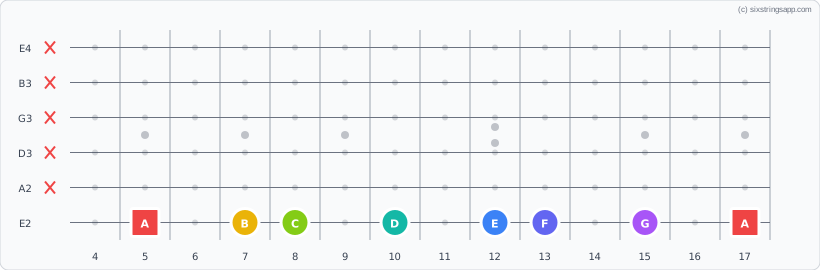
The fret distances are:
+2 +1 +2 +2 +1 +2 +2This is the natural minor formula:
W — H — W — W — H — W — WThis approach helps you see the scale not as a ready-made shape, but as a sequence of distances.
Natural minor on the fretboard
In real playing, natural minor can be played in different places on the neck.
You can play A minor:
- on one string;
- in one position;
- across the whole fretboard;
- with different fingerings.
The notes stay the same, but the feeling under your fingers changes.
It is important not to learn minor only as a shape. It is better to connect the shape with notes and scale degrees:
A B C  D E F  G  A
1 2 b3 4 5 b6 b7 1
To check this in practice, open Fretboard Explorer, choose A natural minor, and turn on scale-degree display. Find all the first degrees, then b3 and 5. This will show you the center and the notes of the minor triad inside the scale.
How natural minor is connected to chords
Chords can be built from the notes of the natural minor scale.
If you take A minor:
A B C D E F Gand build triads using only these notes, you get the chords of natural minor:
| Scale degree | Chord |
|---|---|
| i | Am |
| ii° | Bdim |
| III | C |
| iv | Dm |
| v | Em |
| VI | F |
| VII | G |
These chords sound connected because they are built from the same note set and relate to the same center: A.
Later, it will be important to know that minor-key music often uses more than natural minor. Harmonic minor and melodic minor are also common. For example, in the key of A minor, the E chord is often made major — E or E7 — to create a stronger pull back to Am.
But for the first step, natural minor is enough: it shows the basic minor system without additional changes.
Why guitarists should understand natural minor
Natural minor helps you understand where the minor sound comes from and how it works on the fretboard.
With it, you can:
- build a minor scale from any note;
- see how minor differs from major;
- find minor phrases on the fretboard;
- understand the formula
1 2 b3 4 5 b6 b7; - build simple minor chord progressions;
- see the relationship between A minor and C major.
If you only know a fingering, minor remains a finger pattern. If you understand the formula, you can see which scale degrees create its character.
How to practice natural minor
Do not start with long diagrams. Take A minor and one string.
Try this:
- Find A on the sixth string, fifth fret.
- Play A minor on one string: 5, 7, 8, 10, 12, 13, 15, 17.
- Say the distances out loud: whole step, half step, whole step, whole step, half step, whole step, whole step.
- Play the same notes backward.
- Play only the 1st, b3, and 5th degrees: A, C, E.
- Return to A and listen to the feeling of center.
The goal is to connect the natural minor formula, the sound, and the movement on the fretboard.
5-minute exercise
- Write down the natural minor formula:
W — H — W — W — H — W — W. - Build A minor: A, B, C, D, E, F, G, A.
- Play it on one string.
- Play only A, C, and E.
- Compare A minor with A major: A, B, C#, D, E, F#, G#, A.
- Find which scale degrees are lowered in minor.
- Play a short phrase and end it on A.
The goal is to hear how b3, b6, and b7 change the character of the scale.
Common confusion
- Minor does not always mean sad. Natural minor has a specific structure, but the mood of music depends on context.
- A minor and C major use the same notes, but they are not the same key. They have different centers: A and C.
- Natural minor is not the only minor scale. Harmonic minor and melodic minor also exist. But natural minor is the basic form and a good place to start.
- A minor scale is not just major “from a different note” if you do not hear the new center. The notes can be the same, but the feeling changes only when the center actually changes.
- The formula matters more than the fingering. The same minor scale can have many shapes on the fretboard.
What to learn next
After this topic, these articles are a good next step:
In short
Natural minor is built with this formula:
whole step — half step — whole step — whole step — half step — whole step — whole stepIn scale degrees, it can be written as:
1 2 b3 4 5 b6 b7The main difference from major is the lowered 3rd, 6th, and 7th degrees. Once you understand this formula, minor stops being just a “sad shape” and becomes a clear system of sounds that you can move across the fretboard and into different keys.