What is a scale?
A scale is a set of notes arranged in a specific order by pitch.
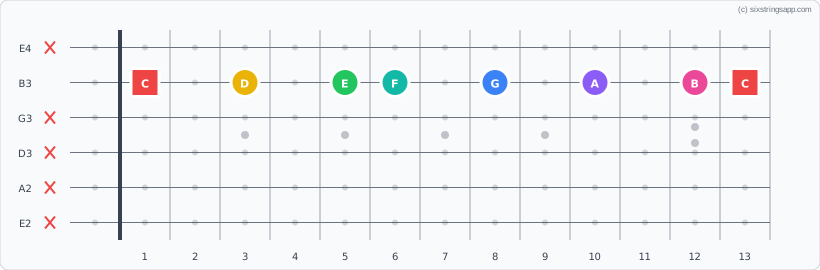
For example, if you play C, D, E, F, G, A, B, and then C again, you get the C major scale:
C D E F G A B CThese notes are not placed at random. There are exact distances between neighboring notes: sometimes a whole step, sometimes a half step. The order of these distances gives the scale its sound and character.
Scales are often learned as exercises: play the notes up, then play them down. That is useful for your fingers, but a scale is more than a technical drill. Its notes can be used to build melodies, riffs, bass lines, and chords.
Why a scale is not a random set of notes
If you pick any seven notes, you will get a set of sounds. But that does not automatically make them feel like a clear scale.
A scale depends on three things:
- the order of the notes;
- the distances between them;
- a home note the music can return to.
The major scale follows this pattern:
whole step — whole step — half step — whole step — whole step — whole step — half stepIf you start from C, you get C major:
C D E F G A B CThere is a half step between E and F. There is also a half step between B and C. All the other neighboring notes are a whole step apart.
A small example: C major
In this example, the scale starts on C and ends on the next C above it. The first C sounds like a starting point. The final C sounds like a return to the same place, only higher.
This feeling of a home note helps separate a scale from a plain list of notes.
Why guitarists need scales
A scale helps you stop guessing which notes to play.
With a scale, you can:
- find notes for a melody;
- create a riff or bass line;
- understand which sounds fit over chords;
- see a connected map of notes on the fretboard;
- train your ear and fingers at the same time;
- compare major, minor, and other scales by sound.
Knowing a scale does not mean you have to play all its notes in order. Often, 2 or 3 notes are enough. Take a few notes, turn them into a short phrase, and repeat that phrase with a different rhythm.
What are scale degrees?
Notes inside a scale can be counted as scale degrees.
In C major, it looks like this:
| Degree | Note |
|---|---|
| 1 | C |
| 2 | D |
| 3 | E |
| 4 | F |
| 5 | G |
| 6 | A |
| 7 | B |
| 8 | C |
The eighth degree repeats the first degree, but higher. That is why it is often treated as the first degree of the next octave.
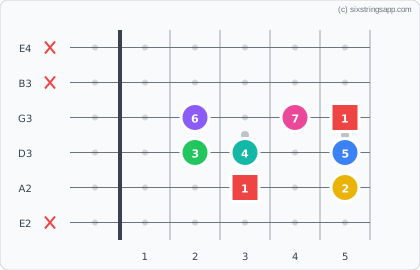
Scale degrees help you talk not only about note names, but also about musical roles. The first degree usually feels like the center. The fifth degree often sounds stable. The seventh degree often wants to move back to the first.
This is explained in more detail in “What Is a Scale Degree?”.
How a scale differs from a key
A scale and a key are connected, but they are not the same thing.
A scale is an ordered set of notes.
A key is the musical environment around a main note. In a key, some notes feel stable, some create motion, and chords take on specific roles.
For example, the C major scale gives you these notes:
C D E F G A BThe key of C major uses those notes as material for melodies, chords, and harmonic movement.
At the beginning, this formula is enough: a scale gives you the notes; a key shows how those notes work around a center.
How a scale looks on the fretboard
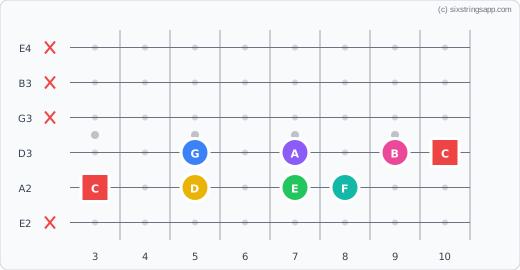
On guitar, the same scale can be played in different places.
You can play C major:
- on one string;
- in one position;
- across the whole fretboard;
- with different fingerings.
The notes stay the same, but the feeling under your fingers changes.
That is why guitarists often learn scales as shapes. Shapes are useful, but they have a risk: you can memorize finger movement without understanding which sounds are inside the shape.
It is better to connect three layers:
- the fingering;
- the note names;
- the scale degrees.
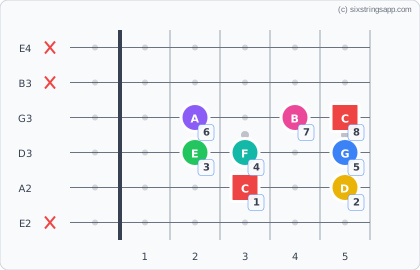
Then a scale stops being a finger pattern and becomes a map of sounds.
To try this in practice, open Fretboard Explorer, choose C major, and switch between notes and scale degrees. First find all C notes, then add the rest of the scale and play a short phrase in one area of the fretboard.
How scales are connected to chords
Chords are often built from the notes of a scale.
For example, if you take the notes of C major and build chords using only those notes, you get the chords of that key.
At first, you do not need to memorize every rule of chord construction. The main idea is simpler: a scale gives you the material, and a chord takes several sounds from that material and plays them together.
A melody can use notes from the same scale too. That is why melodies and chords often feel connected: they rely on the same pool of sounds.
This does not mean you can never play notes outside the scale. You can. But first, it is useful to hear the basic case: one set of notes creates a clear musical environment.
How to practice a scale
Do not play a scale up and down only for speed. First, listen to how the individual degrees sound.
Try this order:
- Play the C major scale upward.
- Name the first note.
- Play only the first three notes: C, D, E.
- Create a short motif from those three notes.
- Return to C and listen to the feeling of arrival.
- Play the scale downward.
- Stop on different degrees and compare how they feel.
This trains both your fingers and your ear.
5-minute exercise
- Take the C major scale: C, D, E, F, G, A, B, C.
- Play it slowly upward.
- Play it slowly downward.
- Play only C, D, and E.
- Create a short phrase from those three notes.
- End the phrase on C.
- Repeat the phrase again, but change the rhythm.
The goal is to hear the scale as a set of connected sounds, not as a finger exercise.
Common confusion
A scale is not just an up-and-down exercise. The exercise helps you remember the sounds, but the scale itself is used for melodies, riffs, chords, and improvisation.
A scale and a key are not the same thing. A scale gives you a set of notes. A key adds a center, stability, and relationships between chords.
A scale and a fingering are not the same thing either. One scale can have several shapes on the fretboard.
You do not need to learn many scales at once. It is better to understand one simple scale, such as C major, than to rush through ten different shapes superficially.
Do not play only with your eyes and fingers. Listen for where the sound feels stable, where it creates motion, and where it wants to return.
What to learn next
After this topic, these articles are a good next step:
- “Tone and Semitone”;
- “Guitar Fretboard Basics”;
- “How to Memorize Fretboard Notes”;
- “What Is a Scale Degree?”.
In short
A scale is an ordered set of sounds. It is not only about the notes, but also about the distances between them, their degrees, and the feeling of a center.
When you understand a scale through sound, degrees, and the fretboard, it stops being a mechanical exercise and becomes a tool for melodies, chords, riffs, and improvisation.