What is a key in music
A key is a system of notes and chords built around one main note.
This main note is called the tonic. It feels like the center of the music: a note you can return to at the end of a melody or chord progression.
In simple words, a key shows where “home” is in music.
For example, if a piece of music is in C major, the main note is C. The notes and chords around it do not feel like a random collection. They feel like parts of one connected system.
The tonic: the main note of a key
The tonic is the first scale degree of a key and its center.
In C major, the tonic is C.
C D E F G A B C
1 2 3 4 5 6 7 1
When a melody returns to C, it often feels complete. Not always: music can deliberately leave tension unresolved. But in simple examples, the return to the tonic is usually easy to hear.
In G major, the tonic is G.
G A B C D E F# G
1 2 3 4 5 6 7  1
The notes have changed, but the principle is the same: the first scale degree becomes the center around which the music is built.
Key vs scale
A scale and a key are related, but they are not the same thing.
A scale is an ordered set of notes.
For example, the C major scale is:
C D E F G A B CA key is more than a set of notes. It has a center, stable notes, tension, resolution, and chords that work around that center.
| Concept | What it shows |
|---|---|
| Scale | which notes belong to the set |
| Key | how those notes work around a center |
A scale gives you the material. A key shows how that material feels and works in music.
Stable and unstable notes
Notes inside a key do not all feel the same.
Some notes feel stable. You can stop on them, and the phrase may feel finished.
Other notes create movement. They seem to ask for continuation or resolution.
In C major, the strongest point of rest is C, the first scale degree. E and G also feel stable because they belong to the C major chord. B, the seventh scale degree, often pulls toward C.
B → C
7 → 1
This pull helps you hear a key not as a table of notes, but as a system of movement and return.
Scale degrees inside a key
Notes inside a key can be understood not only as C, D, E, or G. Each note also has a scale degree number and a role in relation to the tonic.
In C major, it looks like this:
| Degree | Note | Simple role |
|---|---|---|
| 1 | C | center, tonic, “home” |
| 2 | D | movement away from the center |
| 3 | E | major color |
| 4 | F | movement and preparation for tension |
| 5 | G | strong support and a path back home |
| 6 | A | softer color inside the key |
| 7 | B | strong pull toward the tonic |
| 1 | C | return home |
At the beginning, it is more important to understand the principle than to memorize every formal name for every scale degree: the same note can play different roles in different keys.
For example, C is the tonic in C major, the fourth scale degree in G major, and the third scale degree in A minor.
Keys and chords
A key is connected not only to notes, but also to chords.
If you take the notes of C major and build chords only from those notes, you get the chords of the C major key.
In a basic form, they look like this:
| Degree | Chord |
|---|---|
| I | C |
| ii | Dm |
| iii | Em |
| IV | F |
| V | G |
| vi | Am |
| vii° | Bdim |
These chords sound connected because they are built from the same set of notes and relate to the same center: C.
This does not mean that a song cannot use chords from outside the key. It can. But it is useful to understand the basic case first: a key already gives you a set of chords that can be used to build simple progressions.
Why musicians need keys
A key helps you see music as a system.
It makes it easier to:
- find the center of a song;
- choose chords that sound connected;
- move a song higher or lower;
- hear why a melody wants to resolve to a certain note;
- understand chord progressions;
- connect scales, scale degrees, and chords.
For guitar players, this is especially useful. If you only know chord shapes, a song may look like a chain of separate fingerings. If you understand the key, you can see which chords provide rest, which chords create movement, and which chords lead back home.
Keys on the guitar fretboard
On the guitar, you can see a key through notes, scale degrees, and chords.
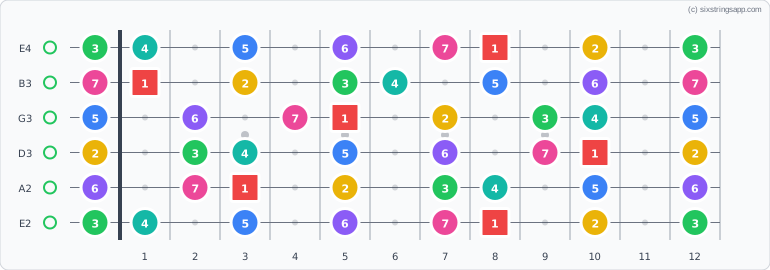
For example, in C major, every C note is the tonic. Every G note is the fifth scale degree. Every B note is the seventh scale degree, which often pulls toward C.
If you look only at note names, the fretboard can feel like a large collection of dots. If you switch to scale degrees, the logic becomes clearer: you can see the center, the stable notes, and the notes that create movement.
To try this in practice, open the Fretboard Explorer, choose C major, and turn on scale degree display. Find all first, fifth, and seventh scale degrees. Then play a short phrase that ends on the first scale degree.
Major and minor keys
Keys are often major or minor.
C major and A minor use the same notes:
C D E F G A BBut their centers are different.
In C major, the center is C. In A minor, the center is A.
Because the center changes, the same notes start to feel different. This is why a key is not just a list of notes. The main question is which note feels like home.
| Key | Notes | Center |
|---|---|---|
| C major | C D E F G A B | C |
| A minor | A B C D E F G | A |
How to find the key of a song
In simple music, you can often find the key by looking for a few signs.
Ask yourself:
- Which note or chord sounds finished?
- Where does the melody return most often?
- Which chord feels like “home”?
- Which notes and chords appear most often?
- Is there a clear movement back to the tonic?
Sometimes a song starts on the tonic. Sometimes it ends on the tonic. But this is not a strict rule. Music can start on a different chord, move away for a while, or even change its center.
As a first step, look for the note or chord that feels the most stable.
How to practice keys
Start with one key, for example C major.
Try this:
- Play the C major scale: C, D, E, F, G, A, B, C.
- Return to C and listen to the feeling of completion.
- Play B, then C.
- Listen to the 7 → 1 resolution.
- Play the notes of the C chord: C, E, G, C.
- Play a simple progression: C → F → G → C.
- Listen to how the final C feels like coming home.
- Then repeat the same idea in G major: G → C → D → G.
The goal is not only to hear the notes, but also to hear the center around which they work.
How to explore keys in Six Strings App
To make this practical, open Harmony and choose C major.
Look at the chords that belong to the key. Then listen to simple progressions and pay attention to how the chords return to C.
After that, open the Circle of Fifths. It helps you see which keys are close to each other and why C major and A minor use the same notes but have different centers.
Common confusion
- A key is not just a scale. A scale gives you notes. A key adds a center, stability, tension, resolution, and chords.
- The tonic is not always the first note of a song. A song can start on another note or chord and still return to the tonic as its center.
- A key is not the same thing as mood. Major is not always happy, and minor is not always sad. The feeling also depends on tempo, rhythm, register, lyrics, timbre, and context.
- The same note can play different roles. C is the tonic in C major, the fourth scale degree in G major, and the third scale degree in A minor.
- Chords outside the key are not forbidden. They add color, tension, or a temporary move away from the center.
What to learn next
- “What Is a Scale in Music”;
- “What Is a Scale Degree”;
- “How to Build a Major Scale”;
- “How to Build a Natural Minor Scale”.
In short
A key is a system of notes and chords built around one main center: the tonic.
A scale shows which notes belong to the set. A key shows how those notes feel: where the music rests, where it moves, where it creates tension, and where it wants to return.
When you understand keys, scales, scale degrees, and chords start to form one system. This helps you analyze songs, build progressions, transpose music, and navigate the fretboard with more confidence.