What does minor mean in music
The word “minor” is often used as a synonym for sadness. That association is understandable as a first impression, but it is too narrow: minor can sound reflective, tense, heavy, calm, or energetic.
Minor is a way of organizing sounds in which the minor third above the root or tonic plays an especially important role.
In music, the word “minor” appears in three related but different expressions:
| Concept | Example | What it means |
|---|---|---|
| Minor chord | A minor: A–C–E | a sonority with a minor third above the root |
| Minor scale | A natural minor: A–B–C–D–E–F–G | a set of scale degrees that provides the basic minor material |
| Minor key | A minor | a musical system where A feels like the center, with melodies and chords working around it |
This article explains what connects these meanings and how to hear minor in practice. The natural minor formula and the method for building it from any note are already covered in “How to Build a Natural Minor Scale”.
The root and the minor third
The easiest way to hear minor is through a chord.
Take A as the root. If you add C and E, you get an A minor chord:
A C  E
1 b3 5
A is the root of the chord. C is its minor third. E is its fifth.
Raise C to C#, and the chord becomes A major:
A major A : A C# E
A minor Am: A C  E
              ↑
          the third changes
Only one note changes, but the sonority feels different.
So it is more useful to begin hearing minor not as a general feeling of “sadness,” but as a specific relationship between notes: a root and a minor third above it.
The minor chord
A minor triad is built with this formula:
1 b3 5For example:
| Chord | Notes | Formula |
|---|---|---|
| A minor | A C E | 1 b3 5 |
| E minor | E G B | 1 b3 5 |
| D minor | D F A | 1 b3 5 |
The notes change, but the relationship between them stays the same. In each case, the third is a minor third above the root, so the chord is heard as minor.
On guitar, the same minor chord can be played with different fingerings. An open Am chord, an Am barre shape, and a small triad higher up the neck differ in register and tone, but their foundation remains the same: A, C, and E.
The structure of triads is covered in more detail in “How Triads Are Built”.
The natural minor scale
A minor chord shows minor in a compact form: root, minor third, and fifth.
The natural minor scale expands this material to seven different notes. For example, A natural minor is:
A B C  D E F  G  A
1 2 b3 4 5 b6 b7 1
The notes of the A minor chord are already inside this scale:
scale: A B C  D E F  G  A
chord: A   C    E
       1   b3   5
The degree b3, the note C, again helps you hear the minor quality in relation to A.
Natural minor is a convenient starting point: it shows the basic minor scale degrees without additional alterations. For the whole-step and half-step formula, the example of A minor, and its layout on the fretboard, see “How to Build a Natural Minor Scale”.
The minor key
A minor scale is a set of notes. A minor key is music in which a minor center feels like the main point of reference.
In A minor, that center is A. A melody can return to it, and the Am chord can feel like the main point of rest.
For example, this progression:
Am → F  → C   → G   → Am
i  → VI → III → VII → i
uses the notes of A natural minor. If you play it so that Am begins and ends the phrase, A can feel like the center, even though the progression also contains the major chords C, F, and G.
Using the notes of A natural minor, you can build these triads:
| Degree | Chord | Notes |
|---|---|---|
| i | Am | A C E |
| ii° | Bdim | B D F |
| III | C | C E G |
| iv | Dm | D F A |
| v | Em | E G B |
| VI | F | F A C |
| VII | G | G B D |
Not every chord in a minor key is minor. A key is called minor not because all its chords sound minor, but because its minor tonic and the relationships around it establish the musical center.
Why A minor and C major are not the same key
A natural minor and C major use the same notes:
A minor: A B C D E F G
C major: C D E F G A B
But they are not the same key.
In C major, C feels like the main center, and the tonic chord is C major.
In A minor, A feels like the main center, and the tonic chord is Am.
| Key | Notes | Center | Tonic chord |
|---|---|---|---|
| C major | C D E F G A B | C | C |
| A minor | A B C D E F G | A | Am |
You can play all the white-key notes and still not make the tonal center clear to a listener. The center emerges through melodic endings, chord movement, the duration of stable notes, and the sense of return.
This is why minor should not be understood merely as “the same notes as major, starting from a different degree.” The important question is which note becomes home.
Natural, harmonic, and melodic minor
A first article about scale construction naturally starts with natural minor. In real minor-key music, however, altered scale degrees are common.
In A natural minor, the seventh degree is G:
A B C  D E F  G  A
1 2 b3 4 5 b6 b7 1
There is a whole step between G and A, so the return to A sounds softer.
Raise G to G#, and you create a stronger pull toward A:
G# → A
7  → 1
This is a characteristic feature of harmonic minor. With G# in A minor, you can use the major E chord or the dominant seventh chord E7, both of which lead more strongly back to Am:
Am → Dm → E7 → Am
i → iv → V7 → iMelodic minor uses another variation of the minor degrees, especially noticeable in melodic movement. It is best explored separately after natural and harmonic minor.
For a first introduction, it is enough to understand this:
- natural minor shows the basic minor scale;
- harmonic minor helps create a stronger return to the tonic;
- in practice, a minor key can use material from more than one minor-scale form.
Minor does not mean sad
Minor often feels darker or softer than major. But it does not guarantee a sad mood.
A minor foundation can sound:
- sad, in a slow ballad;
- reflective, in a calm acoustic part;
- tense, with a dominant chord and a sharp rhythm;
- aggressive, in a heavy guitar riff;
- energetic, in a fast rock or punk song;
- mysterious, in a slow melody with an unusual tone.
For example, an Am chord remains minor whether you play it quietly on an acoustic guitar or sharply with distortion on an electric guitar. The performance character changes, but the chord structure does not.
A more accurate statement is: minor has a specific structure that is often heard as darker or more tense, while the mood depends on the musical context.
How to hear minor
Begin by comparing minor and major chords built from the same root.
- Play A minor:
A, C, E. - Play A major:
A, C#, E. - Listen to how
Cchanges toC#. - Return to Am and try to hear its minor third
A → Cseparately. - Then compare Em and E major in the same way:
E–G–BandE–G#–B.
At first, it is clearer to compare chords built from the same root. If you compare Am with C major, both the center and the chord content change, which makes the role of the third harder to hear.
Then move from an individual chord to a key:
- Play the progression
Am → F → C → G → Am. - End on Am and listen for whether it feels like a return to a point of rest.
- Then play
Am → Dm → E7 → Am. - Compare how much more strongly E7 leads back to Am.
This lets you hear minor not only as one chord, but as the center of harmonic movement.
Minor on the guitar fretboard
On guitar, it is useful to study minor through intervals, not only through ready-made shapes.
Take A as the root. For a minor chord, find these notes in relation to it:
1  = A — root
b3 = C — minor third
5  = E — fifth
For A natural minor, add the remaining degrees:
1 2 b3 4 5 b6 b7 1
A B C  D E F  G  A
If you see only a fingering, it is easy to memorize one shape and lose your bearings when you move it. If you see 1, b3, and 5, you understand why the chord is minor. If you see b6 and b7, it becomes clearer how natural minor differs from major.
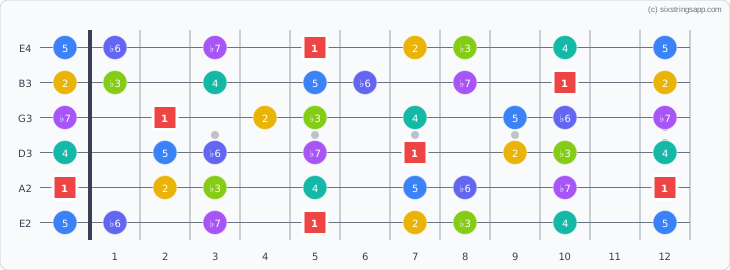
How to explore minor in Six Strings App
To hear minor in harmony, open Harmony and choose A minor.
First, listen to the tonic chord Am. Then play the progression Am → F → C → G → Am and notice the return to Am. If progressions with a dominant chord are available in the tool, compare it with Am → Dm → E7 → Am: in the second progression, the return to the minor tonic is more pronounced.
To see minor on the fretboard, open the Fretboard Explorer, choose A natural minor, and switch the display from notes to intervals. First find 1, b3, and 5: these are the tones of the minor triad. Then look at b6 and b7, which are characteristic of natural minor.
To compare specific chord shapes, open Chords, Arpeggios, and Scales, choose Am, and then A major. In the interval display, compare b3 with 3.
A 5-minute exercise
Take the chords Am and A major.
- For one minute, alternate between Am and A major, listening to the difference between C and C#.
- For one minute, play the notes of Am one by one: A → C → E → A.
- For one minute, play the A natural minor scale up and down, paying attention to A and C.
- For one minute, play the progression
Am → F → C → G → Am, listening to the return to Am. - For the final minute, play
Am → Dm → E7 → Amand compare the strength of the return to the tonic.
The main goal is to connect three expressions of minor:
1–b3–5in a chord;- the degrees of the natural minor scale;
- the sense of a minor center in a chord progression.
Common mistakes
- Thinking that minor always means sad. Minor structure affects character, but mood also depends on tempo, rhythm, timbre, register, harmony, and lyrics.
- Confusing a minor chord with a minor key.
Amis one chord. A minor is a system of sounds and chords centered on A. - Thinking every chord in a minor key is minor. A natural minor contains the major chords C, F, and G.
- Treating A minor and C major as the same key. The notes match, but the center and sense of return are different.
- Confusing natural minor with all minor-key harmony. A minor key often uses a raised seventh degree and a major dominant chord, such as
E7in A minor. - Comparing minor and major from different roots. For ear training, it is clearer to compare Am with A major: the third changes while the root stays the same.
- Memorizing only one fretboard shape. It is more useful to connect a fingering with degrees
1,b3,5, and the minor center.
FAQ
Is minor a chord, a scale, or a key?
The word “minor” is used in all three cases. A minor chord is a sonority with a minor third above its root. A minor scale is a set of scale degrees with a minor quality. A minor key is a musical system in which a minor center feels like the main point of reference.
Does minor always sound sad?
No. Minor is often perceived as darker than major, but the final mood depends on rhythm, tempo, melody, timbre, lyrics, and harmonic context.
What is the most important thing to hear in minor?
At first, listen for the minor third. Compare Am (A–C–E) with A major (A–C#–E): only the third changes, making the difference in character especially clear.
Are natural, harmonic, and melodic minor three different keys?
No. They are different forms of minor material that can be used around the same center. For example, in A minor, the natural scale contains G, while the harmonic form raises it to G# to strengthen the movement toward A.
Why can E7 appear in A minor if natural minor contains G rather than G#?
Because minor-key harmony often raises the seventh degree. G# pulls more strongly toward A, and the E7 chord containing G# creates a clear return to Am.
Do I need to learn the natural minor formula again in this article?
Not if you have already studied the separate article on building it. Here, the more important task is to hear how minor appears in a chord, a scale, and a key. When needed, return to “How to Build a Natural Minor Scale”.
What to learn next
- “How to Build a Natural Minor Scale”;
- “What Is Major in Music?”;
- “How Triads Are Built”;
- “What Is a Key in Music?”;
- “Major vs Minor: What Is the Difference?”.
In short
Minor is not simply a mood. It is a way of organizing sounds in which the minor third above the root or tonic plays an important role.
In a minor chord, you can hear it through the formula 1–b3–5. The natural minor scale shows the basic collection of minor scale degrees. In a minor key, those notes and chords work around a minor center, while altered degrees can also appear in the harmony to create a stronger movement back to the tonic.
Once you can hear the minor third and the minor center, minor stops being a word for “sad music” and becomes a practical tool for playing, analyzing songs, and navigating the fretboard.