The pentatonic scale is often introduced as one convenient guitar shape. This can make it feel like a geometric pattern: place your fingers in the right position, and you are ready to play a solo.
But a fingering is only one way to arrange notes on the fretboard.
A pentatonic scale is a five-note scale with its own formula, tonic, and sound. The same set of notes can function as either a major or minor pentatonic scale. It depends on the harmony and on which note you hear as the tonal center.
Simple definition
A pentatonic scale is a five-note scale.
There are many types of pentatonic scales, but two are especially common in modern guitar music:
major pentatonic
minor pentatonic
Their formulas are:
major pentatonic = 1–2–3–5–6
minor pentatonic = 1–♭3–4–5–♭7
For example:
C major pentatonic = C–D–E–G–A
A minor pentatonic = A–C–D–E–GThese two scales contain the same notes but have different tonics. That is why the same guitar shape can sound major or minor.
Major pentatonic scale
The major pentatonic scale uses this formula:
1–2–3–5–6Starting from C, we get:
C–D–E–G–AThe full C major scale contains seven notes:
C–D–E–F–G–A–BThe pentatonic version leaves out the fourth and seventh degrees:
F = 4
B = 7
That leaves:
C–D–E–G–AThe fourth and seventh degrees create clear half-step resolutions:
F → E
B → C
Those notes are absent from the major pentatonic scale, so it tends to sound more open and less tense.
This does not mean that F and B are “bad” notes. They are essential parts of the full major scale. Removing them simply makes it easier for a beginner to build phrases that do not demand an immediate resolution.
Minor pentatonic scale
The minor pentatonic scale uses this formula:
1–♭3–4–5–♭7Starting from A, we get:
A–C–D–E–GThe A natural minor scale contains seven notes:
A–B–C–D–E–F–GThe minor pentatonic scale leaves out the second and minor sixth degrees:
B = 2
F = ♭6
That leaves:
A–C–D–E–GThe note C creates the minor quality because it is the minor third above A:
A → C = ♭3G adds the minor seventh:
A → G = ♭7These two degrees give the minor pentatonic scale its recognizable minor, blues, and rock character, even though it does not contain every note of the natural minor scale.
Why major and minor pentatonic scales can contain the same notes
Compare these scales:
C major pentatonic = C–D–E–G–A
A minor pentatonic = A–C–D–E–G
They use the same five notes:
A–C–D–E–GWhat changes is the tonic—the note that feels like the center and point of rest.
When C is the center:
C–D–E–G–A
1–2–3–5–6
we hear C major pentatonic.
When A becomes the center:
A–C–D–E–G
1–♭3–4–5–♭7
we hear A minor pentatonic.
These are relative pentatonic scales.
This is why you cannot identify the scale from the fingering alone. You also need to consider the backing chord, the beginning and ending of the phrase, and the notes where the melody comes to rest.
Why the pentatonic scale is useful for improvisation
The common major and minor pentatonic scales contain no half steps between neighboring degrees. This means that short phrases are less likely to create sharp clashes.
They also retain the notes of the main triad.
For C major pentatonic:
C major pentatonic = C–D–E–G–A
C major chord      = C–E–G
For A minor pentatonic:
A minor pentatonic = A–C–D–E–G
A minor chord      = A–C–E
The chord tones provide stability. The remaining notes create movement between them.
But this does not mean that any sequence of pentatonic notes will automatically become a good solo.
A scale and a musical phrase are not the same thing
If you continuously play the pentatonic scale up and down:
A–C–D–E–G–A–G–E–D–Cyou get an exercise, not necessarily a melody.
A musical phrase needs a rhythmic shape:
short idea → pause → responsePauses make the boundaries of a musical idea easier to hear. Repetition makes a motif recognizable. Changes in rhythm, direction, or the final note help develop the phrase.
The pentatonic scale limits the available notes, but it does not replace phrasing.
Chord tones and target notes
Over an Am chord, its own notes are the most stable:
A–C–EThe other notes in A minor pentatonic are D and G:
A–C–D–E–GD and G can lead toward stable chord tones:
D → E
G → AWhen improvising, do not focus only on staying inside the box. Try to end phrases on notes from the current chord.
Over Am, the main target notes are A, C, and E. Over C, they are C, E, and G.
This allows the same pentatonic scale to follow the harmony.
Minor pentatonic over a major chord
In blues and rock, musicians often play a minor pentatonic scale over a major chord or dominant seventh chord with the same root.
For example:
A minor pentatonic = A–C–D–E–G
A7 chord           = A–C♯–E–G
This creates a clash between the minor and major thirds:
C  = minor third
C♯ = major third of the chordThis is not a neutral match. It creates the characteristic tension of blues.
You can use C as a passing note, bend it toward C♯, or contrast it with the major third in the chord. The important thing is to hear the tension instead of treating every note as equally stable.
Pentatonic scale and blues scale
The blues scale is based on the minor pentatonic scale with an added flat fifth.
A minor pentatonic:
A–C–D–E–G
1–♭3–4–5–♭7
A blues scale:
A–C–D–E♭–E–G
1–♭3–4–♭5–5–♭7
The added E♭ is called the blue note:
E♭ = ♭5It adds tension between the fourth and fifth degrees. This makes the blues scale sound sharper and more unstable than the regular minor pentatonic scale.
The pentatonic scale on the guitar fretboard
Guitarists usually learn the pentatonic scale through several connected positions. These are often called box shapes.
A box is not a separate scale. It is simply one area of the fretboard containing the notes of the same pentatonic scale.
A minor pentatonic always contains:
A–C–D–E–GOnly the position of those notes under your fingers changes.
If you memorize the shape without learning the intervals, it is easy to lose the connection with the music. You may be able to move your fingers through the pattern without seeing:
- the tonic;
- the chord tones;
- the neighboring positions;
- the scale along one string;
- the notes where a phrase can resolve.
In each minor pentatonic position, find at least:
1  = tonic
♭3 = minor quality
5  = stable chord tone
For the major pentatonic scale:
1 = tonic
3 = major quality
5 = stable chord tone
One shape, two tonal centers
C major and A minor pentatonic use the same notes, so you can play them with the same fretboard shape:
A–C–D–E–GBut the function of each note changes.
In A minor pentatonic:
A = 1
C = ♭3
E = 5
In C major pentatonic:
C = 1
E = 3
G = 5
Try playing the same position first over Am and then over C.
Over Am, end your phrases on A, C, or E.
Over C, end them on C, E, or G.
The notes do not change, but the tonal center and character of the phrases do.
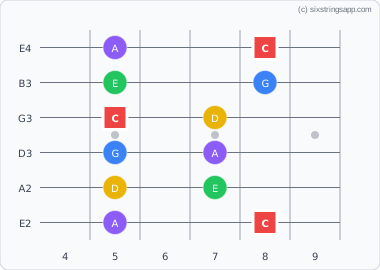
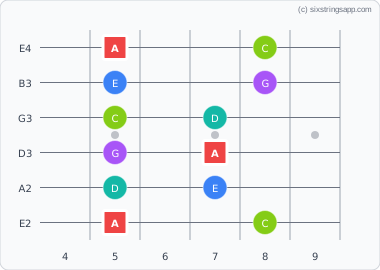
How to learn the pentatonic scale on the fretboard
Open the Fretboard Explorer and select A minor pentatonic.
Start with note names:
A–C–D–E–GFind every A. These are the tonics.
Then switch to interval view:
1–♭3–4–5–♭7After that:
- play the scale in one position;
- play the same degrees along a single string;
- find the notes of the Am chord: A, C, and E;
- connect two neighboring positions with a short phrase;
- finish the phrase on a chord tone.
This way, you learn a system of notes and intervals instead of a geometric shape.
How Six Strings App can help
In the Fretboard Explorer, you can view the pentatonic scale across the entire fretboard, highlight the tonics, and practise with a drone, metronome, and timer.
The Random Key tool gives you a new key for practice and takes you directly to the corresponding scale.
In Harmony, you can check which notes of the current chord are already present in the pentatonic scale.
The Rhythm Generator can create a rhythm that you can use as the basis for a short pentatonic phrase. This helps prevent improvisation from becoming a continuous stream of eighth notes.
5-minute exercise
Play an Am chord or start an A drone.
Use the A minor pentatonic scale:
A–C–D–E–GFor the first minute, use only three notes:
A–C–DAdd E during the second minute.
Add G during the third.
Then build short phrases:
2–4 notes → pause → responseDuring the final minute, end every phrase on a note from the Am chord:
A
C
EThe goal is to hear the difference between stable chord tones and passing notes, not to play as many notes as possible.
Two-chord exercise
Play this progression:
Am → CUse one set of notes:
A–C–D–E–GOver Am, end your phrases on:
A–C–EOver C, end them on:
C–E–GDo not change the fingering. Change only the target notes.
This lets you hear the same note set functioning first as A minor pentatonic and then as C major pentatonic.
Common mistakes
Memorizing only one box shape. One position is enough to begin, but it does not explain how the scale works. Find the tonics and chord tones inside the shape, then connect it to a neighboring position.
Treating the pentatonic scale as a set of safe notes for any harmony. The scale still needs to match the tonal center and the chords. Even an appropriate pentatonic scale can create tension over particular chords.
Playing the scale instead of phrases. Improvisation needs rhythm, pauses, repetition, and development of short motifs.
Not knowing where the tonic is. Without the tonic, the fingering remains a geometric pattern. Find every root note inside each position.
Ending phrases on random notes. Try stopping on notes from the current chord. This makes the connection with the harmony clearer.
Treating relative pentatonic scales as different note sets. C major and A minor pentatonic use the same notes. What changes is the tonic and the function of each degree.
Playing minor pentatonic over the parallel major as if it were a neutral match. In blues and rock, this creates deliberate tension between the minor and major thirds.
What to study next
- What Is a Scale in Music? — the basic idea of a scale.
- What Is a Scale Degree? — scale-degree numbers and functions.
- What Is a Key? — the tonic and tonal center.
- The Major Scale — the seven-note foundation of the major pentatonic scale.
- The Natural Minor Scale — the seven-note foundation of the minor pentatonic scale.
- What Is a Musical Phrase? — how to turn a scale into a complete musical idea.
- What Is a Musical Motif? — how to develop short ideas.
- Fretboard Explorer — a tool for learning the pentatonic scale across the entire fretboard.
Short summary
A pentatonic scale contains five notes. The major pentatonic formula is 1–2–3–5–6, while the minor pentatonic formula is 1–♭3–4–5–♭7.
Relative major and minor pentatonic scales can contain the same notes but have different tonics. This means that the character of the scale depends not on the fingering alone, but on the tonal center and the function of each degree.
The pentatonic scale is useful for improvisation because it contains the notes of the main triad and has fewer strong half-step tensions. But expressive phrasing still depends on rhythm, pauses, target notes, and the relationship with the current chord.