What is the main difference between major and minor
Major and minor are two ways of organizing sounds around a tonal center.
The easiest way to see the difference is to compare chords and scales built from the same starting note. For example, C major and C minor:
C major: C E  G
C minor: C Eb G
           ↑
     the third changes
In both chords, the root is C and the fifth is G. Only the middle note changes: E in major becomes Eb in minor.
Major chord: 1 3  5
Minor chord: 1 b3 5
The third is the quickest and clearest aural clue. A major third creates the major quality; a minor third creates the minor quality.
Important: major and minor are not the same as “happy” and “sad.” Mood depends on tempo, rhythm, tone, register, lyrics, and harmony. But the structure of a chord or scale can be identified precisely.
Are we comparing a chord, a scale, or a key?
The words “major” and “minor” are used in different contexts. When comparing them, it helps to understand what exactly is being discussed.
| What we compare | Major | Minor | Where the difference is heard |
|---|---|---|---|
| Chord | C major: C–E–G | C minor: C–Eb–G | primarily in the third |
| Scale | C major: C–D–E–F–G–A–B | C natural minor: C–D–Eb–F–G–Ab–Bb | in degrees 3, 6, and 7 |
| Key | C major | C minor | in the center, chords, and harmonic movement |
This article compares major and minor as musical systems. Each subject is explained separately in more detail:
- “What Is Major in Music?”;
- “What Is Minor in Music?”;
- “How to Build a Major Scale”;
- “How to Build a Natural Minor Scale”.
Major and minor chords
The best first comparison is between triads built from the same root.
Take C:
| Chord | Notes | Formula | What changes |
|---|---|---|---|
| C major | C E G | 1 3 5 | major third E |
| C minor | C Eb G | 1 b3 5 | minor third Eb |
The root and the fifth stay the same. This lets your ear focus on one change: E becomes Eb.
The same principle works from any root:
| Major | Minor | What changes |
|---|---|---|
| A major: A C# E | A minor: A C E | C# → C |
| E major: E G# B | E minor: E G B | G# → G |
| G major: G B D | G minor: G Bb D | B → Bb |
On guitar, it is useful to check this not only by ear, but also visually: in interval display, a major chord shape contains 3, while a minor chord shape contains b3.
Major and natural minor scales
For a basic comparison, it is most convenient to use natural minor.
Compare the scales built from C:
C major:         C D E  F G A  B  C
                 1 2 3  4 5 6  7  1

C natural minor: C D Eb F G Ab Bb C
                 1 2 b3 4 5 b6 b7 1
Compared with major, natural minor lowers three degrees:
| Degree | C major | C natural minor | What you hear |
|---|---|---|---|
3 / b3 | E | Eb | the main major-or-minor marker |
6 / b6 | A | Ab | a different color in melodic movement |
7 / b7 | B | Bb | a softer return toward the tonic |
This is why the difference between major and natural minor is not limited to one chord. In a chord, the third is enough to reveal the quality. In a scale, a wider set of degrees changes.
Why it is better to compare C major with C minor
For the first comparison, use keys with the same tonic:
C major: C is the tonal center
C minor: C is the tonal center
In English, these are called parallel keys. They share the same tonic, so it is easier to hear how the scale degrees and the overall quality change.
C major and A minor, on the other hand, use the same notes:
C major: C D E F G A B
A minor: A B C D E F G
In English, these are called relative keys: their note collection is the same, but their tonal centers are different.
| Comparison | What stays the same | What changes | What it helps you hear |
|---|---|---|---|
| C major ↔ C minor | the center C | scale degrees and chords | the major and minor quality |
| C major ↔ A minor | the note collection | the center and functions | the relationship between relative keys |
When your goal is to hear the actual difference between major and minor, start with parallel pairs: C major and C minor, or A major and A minor.
How the sound of a key changes
A major or minor key is not only a scale and not only one chord. It is the feeling of a center and the movement toward it.
Compare two simple progressions centered on C:
C major: C  → F  → G  → C
         I  → IV → V  → I

C minor: Cm → Fm → G  → Cm
         i  → iv → V  → i
In the first progression, the tonic chord is C major. In the second, it is Cm. Both return to C, but the quality of the center differs: 1–3–5 in major and 1–b3–5 in minor.
In the minor progression, the chord is G major rather than G minor. This comes from harmonic minor: the note B pulls more strongly toward C and makes the return to Cm clearer. For a first comparison, the important point is simple: minor harmony can use altered scale degrees to strengthen the movement toward the tonic.
Why one chord does not prove the key
Hearing a minor chord in a song does not mean that the whole song is in a minor key.
A major key contains minor chords. For example, C major naturally includes Dm, Em, and Am:
C major: C  Dm Em  F  G  Am Bdim
         I  ii iii IV V  vi vii°
A minor key, in turn, contains major chords. For example, A natural minor includes C, F, and G:
A minor: Am Bdim C   Dm Em F  G
         i  ii°  III iv v  VI VII
To determine whether the center is major or minor, listen not to one isolated chord, but to the whole phrase:
- which chord feels like coming home;
- which note ends the melody;
- which cadences and repetitions appear;
- which third belongs to the tonic chord.
Major and minor on the guitar fretboard
On guitar, the difference is easy to see through intervals relative to the same note.
Take C as the center and first find the triads:
C major: 1 3  5 = C E  G
C minor: 1 b3 5 = C Eb G
Then compare the scales:
C major:         1 2 3  4 5 6  7  1
C natural minor: 1 2 b3 4 5 b6 b7 1
If you display only note names, you need to remember each note’s function every time. If you display intervals, the difference becomes visible immediately: 3 → b3, 6 → b6, 7 → b7.
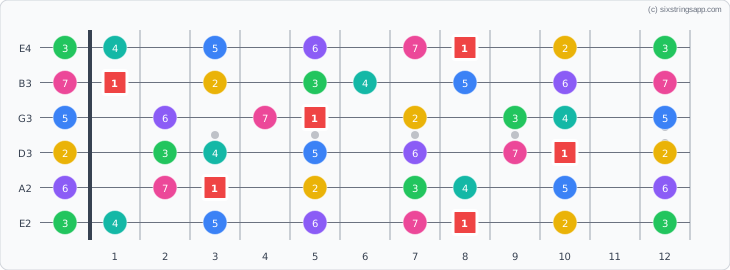
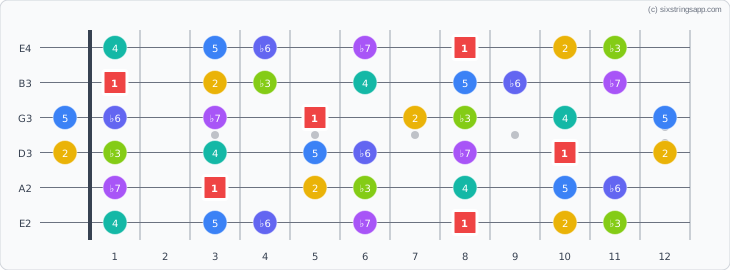
For a guitar player, this is more useful than mechanically memorizing two separate shapes. You see exactly which sounds turn major into minor, and you can apply the same principle from any tonic.
How to hear the difference in one melody
To compare major and minor beyond chords, take a short melody around one tonic.
Major version:
C → E → G → E → C
1   3   5   3   1
Minor version:
C → Eb → G → Eb → C
1   b3   5   b3   1
Only the third changes in the melody. The center C and the fifth G stay the same, so the difference is particularly clear.
After that, you can expand the example into a scale and change the sixth and seventh degrees as well. At first, however, it is enough to hear the role of 3 and b3.
A 5-minute exercise
Use C as the shared center.
- For one minute, alternate between
CandCm, listening to the changeE → Eb. - For one minute, play the major and minor versions of a short melody:
C–E–G–E–CandC–Eb–G–Eb–C. - For one minute, play the C major and C natural minor scales and find the changed degrees:
3/b3,6/b6,7/b7. - For one minute, play the progressions
C → F → G → CandCm → Fm → G → Cm. - For the final minute, find the intervals
3andb3from C in several places on the fretboard.
The main goal is to connect three levels of comparison:
- the third in a chord;
- the changed degrees in a scale;
- the feeling of a major or minor center in harmony.
Common mistakes
- Comparing only mood. Major can sound nostalgic, and minor can sound energetic. Check the structure first:
3orb3. - Comparing C major with A minor when you want to hear the difference in quality. They use the same notes but have different centers. C major and C minor are more useful for a direct comparison.
- Deciding the key from one chord. Both major and minor keys contain chords of different qualities.
- Confusing natural minor with all minor-key harmony. A minor key can introduce a raised seventh degree and a major dominant chord.
- Learning fretboard shapes without intervals. When you can see
3,b3,6,b6,7, andb7, it is easier to transfer the comparison into other keys.
FAQ
Which scale degree matters most when distinguishing major and minor?
The third. A major chord uses a major third (3), while a minor chord uses a minor third (b3). For example, C major contains E, while C minor contains Eb.
Why do the sixth and seventh change when comparing scales?
Because the natural minor scale differs from the major scale in more than its third. Compared with the parallel major scale, its formula contains b3, b6, and b7.
What is the difference between parallel and relative keys?
Parallel keys share the same tonic but use different scale degrees: C major and C minor. Relative keys share the same note collection but have different tonal centers: C major and A minor.
Can a song in a major key use minor chords?
Yes. Some diatonic chords in a major key are already minor. Music also often uses borrowed chords and temporary tonicizations without permanently changing the overall center.
Can one song move from major to minor?
Yes. Music can briefly use a minor color, borrow chords from the parallel minor, or genuinely move into another key. To tell these cases apart, listen for the new center and how firmly it becomes established.
What to learn next
- “What Is Major in Music?”;
- “What Is Minor in Music?”;
- “What Is a Key in Music?”;
- “How Triads Are Built”.
In short
The main audible difference between major and minor begins with the third: major uses 3, while minor uses b3.
When comparing scales from the same center, natural minor differs from major in the degrees b3, b6, and b7. When comparing keys, it is important to hear not one chord, but the center and the harmonic movement toward it.
When you compare parallel versions — such as C major and C minor — and see their intervals on the fretboard, the difference between major and minor becomes clear not only as a feeling, but as music you can play and use.