What does major mean in music
When a beginner first hears the word “major,” it is often associated with something happy or bright. That association can be useful at first, but it does not explain the music precisely.
Major is a way of organizing sounds in which the major third above the root or tonic plays an especially important role.
In practice, the word “major” appears in three related but different expressions:
| Concept | Example | What it means |
|---|---|---|
| Major chord | C major: C–E–G | a sonority with a major third above the root |
| Major scale | C major: C–D–E–F–G–A–B | a set of scale degrees built according to the major-scale formula |
| Major key | C major | a musical system where C feels like the center, with the major scale and its chords working around that center |
This article explains what connects these three meanings and how to hear major in practice. The major-scale formula is already covered in the separate article “How to Build a Major Scale”.
The root and the major third
The easiest way to hear major is through a chord.
Take C as the root. If you add E and G, you get a C major chord:
C E G
1 3 5
C is the root of the chord. E is its major third. G is its fifth.
The note E is especially important for the major quality. Replace E with Eb, and the chord becomes C minor:
C major C : C E  G
C minor Cm: C Eb G
              ↑
          the third changes
Only one note changes, but the character of the sonority changes with it.
So it is more useful to begin hearing major not as an abstract “bright” sound, but as a specific relationship between notes: a root and a major third above it.
The major chord
A major triad is built with this formula:
1 3 5For example:
| Chord | Notes | Formula |
|---|---|---|
| C major | C E G | 1 3 5 |
| G major | G B D | 1 3 5 |
| D major | D F# A | 1 3 5 |
The notes change, but the relationship between them stays the same. In each case, the third is a major third above the root, so the chord is heard as major.
On guitar, the same major chord can be played with different fingerings. An open C chord, a C barre shape, and a small C triad on three strings can sound in different registers and have different tone colors, but their foundation remains the same: C, E, and G.
The structure of triads is covered in more detail in “How Triads Are Built”.
The major scale
A major chord shows major in a compact form: root, third, and fifth.
A major scale expands this material to seven different notes. For example, the C major scale is:
C D E F G A B C
1 2 3 4 5 6 7 1
The notes of the C major chord are already inside it:
scale: C D E F G A B C
chord: C   E   G
       1   3   5
The third scale degree, E, again helps you hear the major quality in relation to C.
A major scale is not merely a sequence of notes to memorize under your fingers. It provides material for melodies and chords. For the pattern of tones and semitones used to build it, see “How to Build a Major Scale”.
The major key
A major scale is a set of notes. A major key is music in which one note is felt as the main center.
In C major, that center is C. A melody and its chords can return to C, while the C major chord feels like the main point of rest.
For example, the simple progression:
C → F  → G → C
I → IV → V → I
starts on C, moves through other chords, and returns to C. The last chord often feels like coming home.
Using the notes of the C major scale, you can build these triads inside the key:
| Degree | Chord | Notes |
|---|---|---|
| I | C | C E G |
| ii | Dm | D F A |
| iii | Em | E G B |
| IV | F | F A C |
| V | G | G B D |
| vi | Am | A C E |
| vii° | Bdim | B D F |
Not all of these chords are major: a major key also contains minor chords and a diminished chord. A key is called major not because every chord in it is major, but because its tonic and overall tonal organization establish a major center.
A major scale and a major key are not the same thing
These concepts are related, but they are different.
| Concept | What it shows |
|---|---|
| Major scale | which notes belong to the major collection |
| Major key | how those notes and chords work around a major center |
You can play the notes of C major up and down as an exercise: that is a scale.
You can play a melody and chords so that C feels like the main center: that is music in the key of C major.
This is why memorizing a scale shape is not enough to understand major. You also need to hear the point of rest, the major third, and the return to the center.
For more on musical centers, see “What Is a Key in Music”.
Major does not mean happy
Major often sounds brighter or more stable than minor. But major does not guarantee a happy mood.
The same major foundation can sound:
- calm, at a slow tempo with a soft tone;
- grand, with wide chords and strong dynamics;
- nostalgic, with a slow melody and fitting lyrics;
- uneasy, with a tense rhythm, unexpected chords, or a harsh tone;
- energetic, in a fast guitar riff.
For example, C major remains a major chord whether you play it gently on an acoustic guitar or sharply and loudly on an electric guitar. The performance character changes, but the chord structure does not.
So instead of saying “major is happy,” it is more accurate to say: major has a specific structure that is often heard as more open or stable, while the mood depends on context.
How to hear major
Begin by comparing a major and minor chord built from the same root.
- Play C major:
C, E, G. - Play C minor:
C, Eb, G. - Listen to the note that changes:
EbecomesEb. - Play C major again and try to focus on its major third.
- Then compare G major and G minor in the same way.
You do not need to find complicated words for the sound immediately. First, hear the contrast: the two chords share the same root and fifth, but a different third changes their character.
Then move from a single chord to a key:
- Play the chord progression
C → F → G → C. - Listen to how the final
Crestores the sense of support. - Then play the C major scale and end on
Cagain.
This lets you hear major in three layers at once: in the chord, in the scale, and in the key’s return to its center.
Major on the guitar fretboard
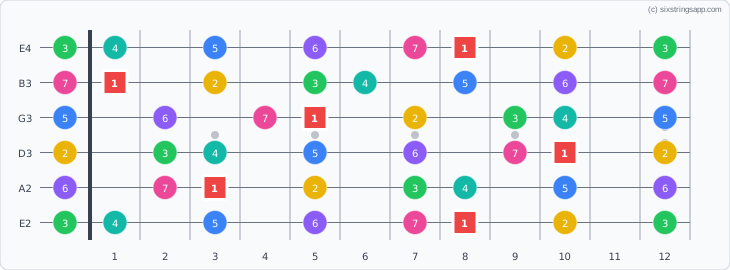
On guitar, it is useful to study major not only through ready-made shapes, but also through intervals.
Take C as the root. For a major chord, find these notes in relation to it:
1 = C — root
3 = E — major third
5 = G — fifth
For the C major scale, add the remaining degrees:
1 2 3 4 5 6 7 1
C D E F G A B C
If you see only a finger shape, it is easy to memorize one fingering and get lost when you move it. If you see 1, 3, and 5, you understand why the chord is major. If you see all the scale degrees, you understand which material is used to build melodies and chords in the key.
How to explore major in Six Strings App
To hear major in harmony, open Harmony and choose C major.
First, listen to the tonic chord C. Then play the simple progression C → F → G → C and notice the return to C.
To see major on the fretboard, open the Fretboard Explorer, choose the C major scale, and switch the display from note names to intervals. First find 1, 3, and 5: these are the notes of the major triad. Then look at the remaining scale degrees.
To compare specific chord fingerings, open Chords, Arpeggios, and Scales, choose C major, and then C minor. In the interval display, notice how 3 becomes b3.
A 5-minute exercise
Take the chords C major and C minor.
- For one minute, alternate between C major and C minor, listening to the difference between E and Eb.
- For one minute, play the notes of C major one by one: C → E → G → C.
- For one minute, play the C major scale up and down, paying attention to C and E.
- For one minute, play the progression C → F → G → C, with one bar per chord.
- For the last minute, open interval display on the fretboard and find the degrees
1,3, and5from C in several places.
The main goal is to connect three expressions of major:
1–3–5in a chord;- the degrees of the major scale;
- the feeling of a major center in a chord progression.
Common mistakes
- Thinking that major always means happy. Major structure affects the character, but mood also depends on tempo, rhythm, timbre, register, harmony, and lyrics.
- Confusing a major chord with a major key. C major
Cis one chord. The key of C major is a system of notes and chords around the centerC. - Thinking every chord in a major key is major. C major includes
Dm,Em,Am, andBdim. - Repeating the scale formula without checking the sound. You need not only to know the notes, but also to hear the center and the major third.
- Memorizing only one shape on the fretboard. It is more useful to connect a shape with scale degrees
1,3,5, and the tonic. - Comparing major and minor using different roots. At first, compare C major with C minor, not C major with A minor: this way, the third changes while the root stays the same.
FAQ
Is major a chord, a scale, or a key?
The word “major” is used in all three cases. A major chord is a sonority with a major third above its root. A major scale is a set of degrees built according to the major-scale formula. A major key is a system in which a major center is felt as the main point of reference.
Does major always sound happy?
No. Major is often perceived as brighter than minor, but the final mood depends on tempo, rhythm, melody, timbre, lyrics, and harmonic context.
What is the most important thing to hear in major?
At first, listen for the major third. Compare C major (C–E–G) and C minor (C–Eb–G): only the third changes, and that change makes the difference especially clear.
Do I need to learn the major-scale formula again in this article?
Not if you have already worked through the separate article on building a major scale. Here, the important task is to hear how major appears in a chord, a scale, and a key. When needed, return to “How to Build a Major Scale”.
Why are there minor chords in a major key?
Because chords are built from different degrees of the same major scale. In C major, the center is C and the tonic chord is C major, but other degrees naturally produce chords such as Dm, Em, and Am.
What to learn next
- “How to Build a Major Scale”;
- “What Is a Chord in Music?”;
- “How Triads Are Built”;
- “What Is a Key in Music?”.
- “Major vs Minor: What Is the Difference?”.
In short
Major is not simply a mood. It is a way of organizing sounds in which the major third above the root or tonic plays an important role.
In a major chord, you can hear it through the formula 1–3–5. In a major scale, a complete set of notes appears around the first degree. In a major key, those notes and chords work around a major center.
Once you can hear the major third and the tonal center, major stops being a word for “happy music” and becomes a practical musical tool for playing, analyzing songs, and navigating the fretboard.