What is a fretboard position
A fretboard position is a working hand placement that allows your fingers to play several neighboring frets without a large movement up or down the neck.
In the basic approach, a position is named after the fret where the index finger is placed. If the index finger works around the fifth fret, this is called fifth position or V position.
The fingers are usually assigned like this:
| Finger | In fifth position, usually covers fret |
|---|---|
| 1 — index | 5th |
| 2 — middle | 6th |
| 3 — ring | 7th |
| 4 — little finger | 8th |
Fifth position:

Frets:    5     6     7     8
Fingers:  1     2     3     4
This is not a strict rule that forbids you from reaching outside four frets. In real music, you can stretch a finger, shift the hand, or briefly play a nearby note. A position is not meant to restrict you. It is a reference point: where the hand is now and how to organize its movement efficiently.
Why positions matter
When a beginner sees the whole guitar neck, it can look like one long strip of frets where it is easy to get lost. Positions divide the fretboard into smaller working areas.
Understanding positions helps you:
- stop searching for every note from scratch;
- play short phrases without unnecessary jumps of the hand;
- learn scales and arpeggios in manageable areas;
- see several ways to play the same note;
- connect familiar shapes to each other;
- choose deliberately when to stay in one area and when to move higher or lower on the neck.
For a guitar player, a position is a navigation tool. Instead of trying to cover the whole fretboard at once, you understand which area you are working in now and where you can move next.
Position and fret are not the same thing
A fret and a position are connected, but they do not mean the same thing.
A fret is one specific location on the fretboard where a pressed string produces a certain pitch.
A position is a hand placement that gives access to several neighboring frets across different strings.
| Concept | What it means | Example |
|---|---|---|
| Fret | one specific place where a string is fretted | 5th fret on the second string |
| Position | the hand’s working area | fifth position: the fingers work around frets 5–8 |
Playing one note at the fifth fret does not yet tell you which position you are using to build the whole phrase. Position becomes useful when you need to play several notes in sequence and organize the movement of your fingers.
What fifth position looks like
Let us take fifth position in standard guitar tuning. The index finger is near the fifth fret, and the other fingers are ready to work nearby.
Frets:      5      6      7      8
Fingers:    1      2      3      4

1st string: A             B      C
2nd string: E      F             G
3rd string: C             D
4th string: G             A
5th string: D             E      F
6th string: A             B      C
This area already contains many notes of the C major scale: C, D, E, F, G, A, and B. The hand stays in one place, while the notes are distributed across several strings.
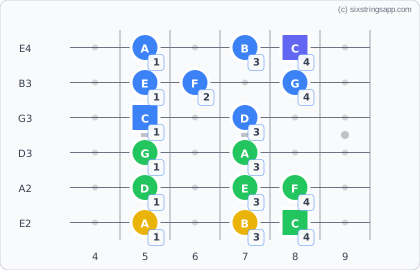
This does not mean that C major exists only in fifth position. The same notes repeat across the entire fretboard. A position simply shows one convenient area where you can work with them.
The same phrase in different areas of the fretboard
A position is easier to understand when you compare two ways of playing the same phrase.
Take the notes C–D–E–F–G.
On the second string, you can play this phrase with a noticeable movement along the neck:
You can also play the same notes in fifth position by using the third and second strings:
In the second version, the hand does not travel along the neck: it remains in fifth position. This is often more comfortable if the phrase continues near the same frets.
But the first version is not wrong. Sometimes a melody is deliberately played on one string for its different tone, for slides, or for a more expressive movement. Understanding positions helps you choose consciously rather than treating one path as the only correct one.
Position and fingering: what is the difference?
It is easy to confuse a position with a fingering.
A position answers the question: which area of the fretboard is the hand working in?
A fingering answers the question: which fingers and strings should be used to play the specific notes?
For example, the phrase C–D–E–F–G can be played in fifth position. Its fingering in this version is:
Notes:    C  D  E  F  G
String:   3  3  2  2  2
Fret:     5  7  5  6  8
Finger: 1 3 1 2 4| Concept | What it shows |
|---|---|
| Position | the general working area of the hand: here, fifth position |
| Fingering | the exact route: strings, frets, and fingers for the phrase |
You can play different phrases in the same position. You can also play one phrase with different fingerings, sometimes in different positions.
Position and scale shape are not the same thing
Guitar players often say “scale position” when they mean a familiar shape on the fretboard. This is useful in practice, but it is important to separate two ideas.
A position describes where the hand is working.
A scale shape shows which notes of a chosen scale are available in that area.
For example, you can play the notes of C major in fifth position. But in the same working area, you can look for the notes of A minor, a C major arpeggio, an individual riff, or a melody. The position remains an area; the musical material changes.
If you simply move a familiar shape higher or lower, the pitch of every note changes. That is why it is useful to connect a shape not only with finger movements, but also with its tonic, notes, and intervals.
Position shifts
Staying in one position is not always comfortable, and it is not always musical.
A position shift is a movement of the hand along the neck in order to continue a phrase, reach another register, or choose a more suitable sound.
For example, you can begin a melody in fifth position and move higher if the phrase rises to higher notes. In a riff, you can shift position for a slide. In accompaniment, you can move to another chord shape so that it connects more smoothly with the shapes around it.
A good position shift usually:
- happens at a clear point in the phrase;
- does not cause the hand to tighten suddenly;
- prepares the next note in advance;
- supports the tone and character needed for the part.
Moving the hand is not the mistake. The mistake is moving randomly, differently each time, without knowing where you need to arrive.
How position connects to notes and intervals
If you learn only shapes, it is easy to memorize a “box” and get lost as soon as the hand shifts.
It is more useful to see which notes and intervals are inside a position.
For example, with C as the reference note in fifth position, you can find:
C = 1  — root
D = 2  — second
E = 3  — third
F = 4  — fourth
G = 5  — fifth
A = 6  — sixth
B = 7  — seventh
C = 8  — octave
Then a position becomes more than a finger pattern. It becomes a small map: you know where the root is, where the fifth is, where the third is, and where you can move the phrase.
This is especially useful for improvisation and melody building. You are no longer simply running through memorized dots: you are choosing notes relative to a center.
Positions in chords and arpeggios
Positions are useful not only for scales.
The same chord can be played in different areas of the fretboard. For example, C major can be played as an open shape near the nut or as a small triad higher up the neck. When you play a chord progression, nearby shapes in one area can create smoother transitions.
The same applies to arpeggios. If a chord’s notes are arranged inside one position, they are easier to use in a picking pattern, melody, or solo.
Working with positions therefore connects several topics:
- notes on the fretboard;
- fingerings;
- scales;
- chords;
- arpeggios;
- melodic phrases.
How to choose a position for a phrase
Do not begin with the question, “Which position is correct?” Begin with the musical task.
- Identify the notes you need to play.
- Find them in one comfortable area of the fretboard.
- Check whether the phrase falls naturally under the fingers without unnecessary tension.
- Look at where the next note or chord is located.
- Compare this option with another one higher or lower on the neck.
- Choose the version that is easy to repeat and suits the sound you need.
Sometimes the best option is one position. Sometimes it is a clear shift between two positions. The goal is not to avoid moving your hand forever, but to make movement controlled.
How to practise positions
Start with one area, such as fifth position.
- Place your index finger in the area of the fifth fret.
- On each string, play the notes available to fingers
1,2,3, and4without shifting your hand. - Find every C note in this position.
- Find the nearby notes of the C major scale.
- Play the phrase C–D–E–F–G.
- Then play the same phrase in another area of the fretboard.
- Compare comfort, tone, and the accuracy of your transitions.
You do not need to learn five or seven shapes at once. One position that you understand through notes and intervals is more useful than several shapes memorized only by the fingers.
The main goal is to connect hand placement with the notes you are playing. A position should become a clear area of the fretboard, not an abstract diagram.
Common mistakes
- Thinking that a position is one fret. A fret is one specific location on a string. A position is a working hand placement around several frets.
- Learning a position as a dot pattern without notes. This makes the shape easy to forget and difficult to apply in music.
- Trying to cover the whole fretboard at once. It is more useful to understand one area well and then connect it to neighboring positions.
- Never changing position. Shifts are needed for range, tone, and comfortable phrasing.
- Moving a shape without noticing that the notes have changed. When you move a shape along the neck, its pitches and musical context change.
- Confusing position with fingering. Position is the area where the hand works; fingering is the specific choice of fingers for the material.
- Choosing a position without considering what follows. A comfortable beginning can lead to an awkward next movement.
FAQ
Are position and fret the same thing?
No. A fret is one specific location on the fretboard. A position is a working hand placement, usually named after the fret near which the index finger is placed. In fifth position, the index finger usually works at the fifth fret, while the other fingers cover neighboring frets.
How many frets are included in one position?
In the basic approach, the hand covers four neighboring frets: one for each fretting-hand finger. In real playing, you can stretch, take nearby notes, and shift position. Four frets are a useful starting point, not a strict rule.
Do I need to learn every position at once?
No. It is better to choose one area, learn its notes and intervals, play a few short phrases there, and only then connect it to a neighboring position.
Can the same phrase be played in different positions?
Yes. The same notes can be found in different places on guitar. Different positions produce different fingerings, transitions, and shades of tone.
Do positions apply only to scales?
No. You can play melodies, riffs, arpeggios, and chord shapes in positions. A position describes the working area of the hand, not one specific type of musical material.
What to learn next
- “Guitar Fretboard Basics”;
- “How to Memorize Fretboard Notes”;
- “What Is Fingering on Guitar?”;
- “What Is a Scale in Music?”.
In short
A fretboard position is a working hand placement, usually named after the fret assigned to the index finger.
Within one position, you can play notes, scales, arpeggios, chord shapes, and short phrases without unnecessary shifts of the hand. At the same time, a position does not forbid movement: a skilled guitarist can stay in a comfortable area when it helps and shift deliberately when the music requires it.
When you learn positions together with notes and intervals, the fretboard changes from a set of diagrams into a clear map for playing and finding musical ideas.