Tension can last for a beat, several measures, or an entire section. But sooner or later, the ear notices a moment when the music reaches a more settled point.
That moment is resolution.
In “What Is Tension in Music?”, we looked at where musical expectation comes from. In “Stable and Unstable Notes”, we examined which scale degrees feel like points of rest and which create a stronger pull forward.
Now we can focus on the transition itself:
tension → a more stable pointResolution is a movement from a less stable state toward a more stable one within a given musical context.
The important word is movement. Stability describes the state of a note or harmony. Resolution describes what happens between two states.
Resolution does not always mean returning to the tonic
One of the clearest examples is:
B → C
7 → 1
But the destination does not have to be the first scale degree.
In C major, F → E can also function as a resolution. The note F moves to E, a note of the tonic triad, even though the tonic note C itself does not appear.
A more useful way to think about resolution is:
unstable point → convincing point of restThat point of rest may be:
- the tonic;
- another stable scale degree;
- a chord tone of the current harmony;
- a more stable chord;
- a local point of rest within a phrase.
Resolution can happen on different levels
1. Resolution of a single note
The simplest case is one melodic note moving to another.
For example:
B → CB creates expectation; C releases it.
But the timing can change:
B → C
B —————→ C
The destination is the same in both cases, but the second version holds the tension longer.
The strength of a resolution therefore depends not only on the interval, but also on how long the expectation is held.
2. Resolution within the same harmonic context
The harmony can remain essentially in place while one or more voices move.
A simple guitar example is:
Csus4 → C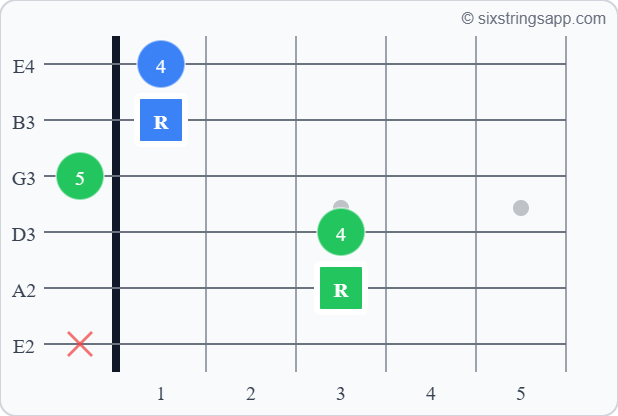
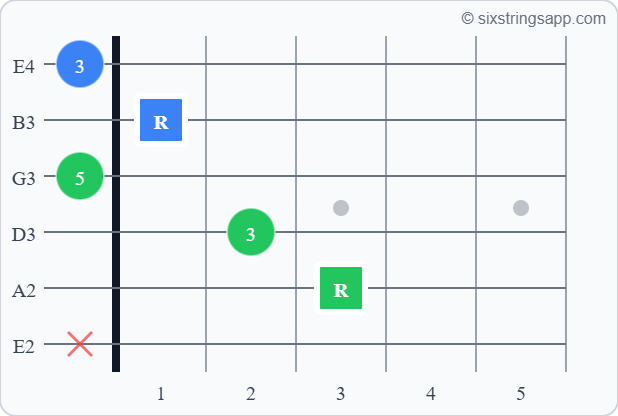
The essential motion is:
F → E
4 → 3
The bass and tonal center remain the same. What changes is the internal structure of the sonority: the suspended fourth moves to the third.
This is an important case because resolution does not require a change of harmonic function or a move to a different chord. Sometimes it happens inside an almost stationary harmony.
Why resolution often moves by step
In tonal music, a tendency tone is often close to its destination:
B → C
F → E
G♯ → A
Stepwise motion works well for two reasons.
First, the ear easily hears neighboring notes as part of the same melodic line.
Second, smooth voice leading favors small movements. One voice can move by step while the others remain in place.
A useful principle is:
If a voice can reach its destination by step, it does not need to make a large leap.
But stepwise motion is not a requirement for resolution. For example:
D → C
2 → 1
moves by a whole step and can still produce a clear sense of arrival.
Harmonic resolution
An entire chord can also resolve.
The classic example is:
G7 → C
V7 → I
The G7 chord contains two particularly directional tones:
B → C
F → E
Together, B and F form the tritone inside G7. In the move to C, both voices resolve by step into notes of the tonic chord.
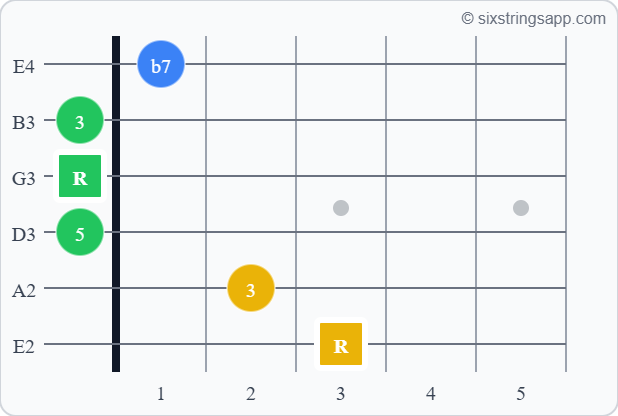
The effect of V7 → I comes from more than the bass motion G → C. Several voices reach more stable positions at the same time.
This is why voice leading is central to understanding resolution. Chord symbols show the vertical sonorities; the actual sense of motion comes from the lines that connect them.
Resolution and cadence are not the same thing
The two ideas are related, but they answer different questions.
Resolution describes what happened to the tension:
tension → point of restCadence describes what happened to the musical phrase:
closure
pause
or expectation of continuation
For example, G7 → C can simultaneously be:
- a harmonic resolution;
- part of an authentic cadence;
- the end of a phrase.
But the same G7 → C motion can also appear in the middle of a longer phrase. The voices resolve, while the musical idea continues.
The opposite is also possible. A half cadence ends a phrase on the dominant. The form pauses, but the harmonic tension remains.
The main types of phrase endings are covered in “What Is a Cadence in Music?”.
Partial resolution
Resolution does not always remove all tension at once.
Compare two progressions in C major:
G7 → C
V7 → I
and:
G7 → Am
V7 → vi
In the second case, the expected tonic does not appear. Yet some voices can still move very naturally:
B → C
F → E
In other words, some of the unstable intervals resolve even though the harmony moves somewhere other than the expected tonic.
This distinction matters:
Individual voices can resolve even when the harmony does not reach the expected tonic.
So the question “Did it resolve?” does not always have a single answer. You need to specify the level: a note, an interval, a chord, or the entire phrase.
Delayed resolution
Once the ear expects a destination, you can postpone it.
For example:
Csus4 ——— Cor in a melody:
B —————→ CThe longer the directional tone is held, the more noticeable the arrival becomes.
But delay works only when the destination is already clear from context. If the tonal center has not been established, a long note may simply sound like a sustained pitch rather than tension waiting to resolve.
Delayed resolution is especially useful:
- before a strong beat;
- before the end of a phrase;
- before a new section;
- at a melodic climax;
- inside a
suschord; - before the final tonic.
Resolution can be redirected
An expected destination is not an obligation.
If the dominant moves somewhere other than the tonic, the ear notices the difference between expectation and result.
For example:
G7 → Am
V7 → vi
This motion appears in deceptive cadences. The full classification belongs to the topic of cadences; for resolution, the important principle is simpler:
An expected destination can be confirmed, delayed, or redirected.
A composer controls not only tension itself, but also when and how that tension is released.
Tension can disappear without the note moving
There is another important possibility.
Imagine the note F sounding over a C chord. As the fourth scale degree, it creates noticeable friction.
You can resolve it in the usual melodic way:
note    F → E
chord   C stays
But you can also keep F in place and change the harmony:
note    F stays
chord   C → F
In the second case, the pitch does not move, but its function changes: F becomes the root of the new chord.
Strictly speaking, this is not ordinary melodic resolution of the voice. It is a change of context that removes the previous tension.
The distinction is useful:
Did the voice move to its destination, or did the harmony change the meaning of the voice?
What makes a resolution stronger?
The same motion can sound more or less conclusive depending on context.
Resolution is usually emphasized by:
- semitone motion;
- a long sustained tendency tone;
- arrival on a strong beat;
- the top voice moving to a stable scale degree;
- the tonic in the bass;
- root position in the destination chord;
- a pause after the arrival;
- the end of a musical phrase.
The sense of closure is weakened by:
- passing quickly through the destination note;
- arrival on a weak beat;
- continued melodic motion;
- an inverted destination chord;
- a non-tonic bass note;
- immediate introduction of new tension.
Resolution is therefore not an on/off switch. It can be strong, weak, partial, or temporary.
How to hear resolution
Instead of asking only “Which scale degree is this?”, listen to the process.
Step 1. Find the moment of expectation
Pause an example just before the final note or chord.
Ask:
Could the music stop here, or do I want to hear what comes next?
Step 2. Imagine the destination
Try to sing the next note internally before it plays.
If the tonal expectation is strong enough, you can often predict the direction.
Step 3. Listen to what actually happens
Compare your expected destination with the real continuation.
Three common outcomes are:
- the expectation is confirmed;
- the resolution is delayed;
- the music moves somewhere else.
Step 4. Isolate one voice
In a chord progression, do not try to hear the entire sonority at once.
Start with one line:
B → C
F → E
G♯ → A
One clear voice can often explain the effect of the entire harmonic transition.
How to use resolution in melody
Establish the destination before it arrives
For a note to sound like a resolution, it needs to be prepared by expectation.
For example:
B — B — Cusually creates a stronger sense of arrival than an unrelated:
E — G — CIn the first example, C is prepared by the directional pull of B.
Control how long the tense note lasts
A short:
B → Ccreates light motion.
A longer:
B —————→ Cmakes the arrival more prominent.
Resolve voices independently
You do not need to move every note of a chord in the same way.
Look for the shortest voice-leading lines:
B → C
F → E
and keep common tones in place.
This makes chord progressions sound connected even when the bass moves by larger intervals.
Sometimes do not resolve
An open ending may be more useful than a closed one.
Leave tension unresolved when you want to:
- move into the next section;
- end a question-like phrase;
- create a loop;
- delay a climax;
- prepare the next chord.
Unresolved tension works only when the listener has had enough context to feel what the expected destination was.
How to see resolution on the guitar
On guitar, it is useful to study the movement of individual fingers rather than only the chord names.
Csus4 → C
Try to keep the other strings as stable as possible and listen specifically to:
F → EG7 → C
First play the complete chord shapes. Then isolate the upper voices:
F → E
B → C
The goal is to connect the familiar sound of V7 → I with specific voice movements on the fretboard.
How to explore resolution in Six Strings App
In Harmony, choose a key and compare dominant and tonic chords. Do not stop at the function labels: look at which notes belong to each chord and where each voice can move.
In the Chord Functions Trainer, listen to the dominant function in context. Try to predict the tonic before you hear the continuation.
In Fretboard Explorer, switch to interval labels and find neighboring pairs such as:
7 → 1
4 → 3
Then move the same relationships into another key. The note names change, but the logic remains the same.
A 10-minute exercise
1. Play the same destination two ways
In C major:
B → C
B —————→ C
Compare immediate and delayed resolution.
2. Resolve a sus chord
Play:
Csus4 → CListen for F → E rather than treating the two chord shapes as separate blocks.
3. Play the dominant and stop
Play:
G7Do not continue immediately. Imagine the next chord.
After a short pause, play:
G7 → CDid the actual destination match what you expected?
4. Redirect the expectation
Compare:
G7 → C
G7 → Am
Notice which voices can still move smoothly in the second progression even though the expected tonic never appears.
5. Find a local resolution without the tonic note
Over a C chord, play:
F → EThe goal is to hear resolution into the third scale degree instead of assuming that every resolution must end on C.
6. Write an open ending
Create a short melody in C major.
End the first version with:
B → CEnd the second version on B.
Compare the closed and open endings.
Common mistakes
Treating any upward or downward motion as resolution. Resolution requires context: a less stable point must move toward a more convincing point of rest.
Assuming that resolution always leads to the tonic. A local voice can resolve into the third or fifth scale degree without completing the entire harmonic motion.
Confusing stability with resolution. Stability is a state. Resolution is the transition toward a more stable state.
Confusing resolution with cadence. Resolution can happen inside a phrase. A cadence concerns the boundary and formal function of the phrase.
Looking only at chord symbols. The sense of resolution is often best explained by the movement of individual voices.
Assuming that a semitone is required. Semitone motion creates a strong tendency, but a whole step can also lead convincingly to a stable scale degree.
Expecting all tension to disappear at once. Some voices can resolve while the harmony retains or creates new tension.
Resolving everything immediately. Delay and redirection make musical motion less predictable.
What to study next
- “Stable and Unstable Notes” — which scale degrees create rest and direction.
- “What Is Tension in Music?” — where musical expectation comes from.
- “What Is a Cadence in Music?” — how harmonic motion relates to phrase endings.
- “What Is Chord Function?” — why some chords create stability while others strengthen expectation.
Summary
Resolution is not one specific pair of notes, and it does not always mean returning to the tonic.
It is a process:
less stable state → more stable point
It can happen:
- within a melodic line;
- inside a chord;
- between chords;
- at the end of a phrase.
Semitone motion often makes the destination especially clear, but it is not required. Resolution can be delayed, weakened, partial, or redirected.
The key skill is not only to hear tension, but to hear which destination that tension makes you expect, and what happens when the destination arrives — or does not.