What is fingering
Fingering is the choice and placement of fingers used to play notes, a chord, a scale, or a musical phrase.
On guitar, the same note can appear on different strings. The same chord can be played in several areas of the fretboard. So a musician needs to choose not only what to play, but also how to play it with the hand.
For example, a C major chord consists of the notes C, E, and G. You can play it as an open shape near the nut, as a small triad on three strings, or as another shape higher up the neck. The chord remains C major, while the fingering changes.
A simple way to remember this is:
- Notes or chord — the musical material
- Fingering — the way to play it on an instrument
How guitar fingers are numbered
In fretting-hand fingering, the fingers are usually numbered like this:
| Symbol | Fretting-hand finger |
|---|---|
| 1 | index finger |
| 2 | middle finger |
| 3 | ring finger |
| 4 | little finger |
| 0 | open string: no finger presses a fret |
The thumb usually has no number in basic diagrams: it supports the neck from behind. In some techniques, it can be used to fret a bass string, but that is a separate technique.
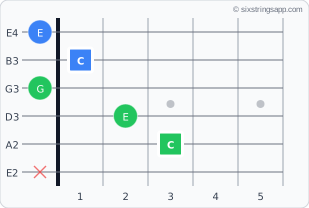
For example, in an open C major shape:
String:  6  5  4  3  2  1
Fret:    x  3  2  0  1  0
Finger:  -  3  2  0  1  0
x means that the sixth string is not played. The ring finger frets the third fret of the fifth string, the middle finger frets the second fret of the fourth string, and the index finger frets the first fret of the second string. The open strings ring without being fretted.
Fingering is not only for chords
The word “fingering” is often used alongside chord diagrams, but it does not apply only to chords.
You choose fingering for:
- a single chord;
- a chord progression;
- a scale;
- an arpeggio;
- a melody;
- a solo or riff;
- a technical exercise.
For example, when you play a scale in one position, you need to decide which finger will fret each note. When you play a riff, you need an option that avoids unnecessary jumps and leaves your hand ready for the next note.
So fingering is not only a pattern of dots on a diagram. It is a plan for how the hand moves.
Why the same note can be played in different ways
The guitar is designed so that notes of the same pitch can appear on different strings.
For example, the same C note can be played at:
- 1st fret on the 2nd string;
- 5th fret on the 3rd string.
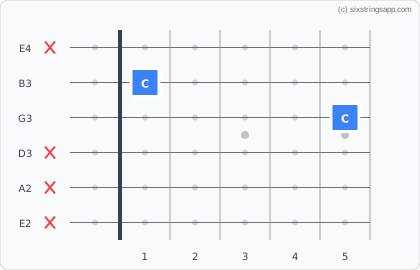
Both notes are the same C at the same pitch. But they feel different under the hand, and their tone can differ slightly: a note on a thicker string usually sounds fuller.
The same applies to a short phrase. The notes C–D–E–F can be played on one string, with a noticeable shift of the hand:
Or you can place the same phrase closer together within one area of the fretboard:
The notes are the same: C–D–E–F. But in the second version, it is easier to stay in one position and prepare your fingers for the continuation of the phrase.
This is the practical purpose of fingering: to choose a route across the fretboard that suits the musical task.
A comfortable fingering depends on context
A phrase does not always have one correct fingering.
One option may be more comfortable in a slow exercise. Another may work better in a fast riff. A third may be preferable in a melody where you want to keep the tone of one string. A fourth may help if the next phrase begins in another area of the fretboard.
When choosing a fingering, check a few things:
| Question | Why it matters |
|---|---|
| Does the hand stay relaxed? | unnecessary tension interferes with accuracy and speed |
| Are there unnecessary jumps across the fretboard? | extra movement increases the risk of mistakes |
| Is it easy to move into the next note or chord? | a phrase exists inside music, not on its own |
| Can you play the option the same way several times? | consistency matters more than one lucky take |
| Does the sound of the chosen string suit the phrase? | the same pitch can have a different tone on another string |
A good fingering is not the most “clever” or the most complex option. It is the one that helps you play the music cleanly, freely, and consistently.
Fingering and fretboard position
A position is an area of the fretboard where your hand is placed. Fingering is the specific choice of fingers within that area or when moving between areas.
For example, if your index finger is near the fifth fret, you can play several notes around the fifth to eighth frets without moving your hand very far. This is playing in one position.
But within the same position, you can use different fingers and different strings. A position limits the general area of movement; fingering describes the specific way to play the material.
Fretboard positions deserve a separate explanation. For now, remember this: fewer unnecessary movements usually make playing easier to control, but avoiding every position shift at all costs is not useful either.
A chord and its fingering are not the same thing
This difference is especially important on guitar.
- A chord is a set of notes that work together.
- A chord fingering is one way to arrange those notes across strings and frets.
For example, the core notes of C major are:
C E G
1 3 5
In one fingering, these notes may be repeated across open strings. In another, they may sound higher up the neck. In a third, they may appear as a small triad on three strings.
The shape changes. The register and tone change. But the chord is still based on the notes C, E, and G.
This helps you move beyond “I only memorized the picture.” Once you understand the notes inside a chord, new fingerings become variations of the same musical material rather than unrelated diagrams.
Fingering and tablature are not the same thing either
Tablature shows which string and fret to play:
B|--1--3--5--6--|
G|--------------|
But tablature does not always tell you which finger should play each fret.
Fingering answers that question:
String:  2  2  2  2
Frets:   1  3  5  6
Fingers: 1  3  1  2   ← with a position shift
Or, for another location of the same notes:
String:  3  3  2  2
Frets:   5  7  5  6
Fingers: 1  3  1  2   ← within one area of the fretboard
Tablature helps you locate the notes. Fingering helps you decide how to play them comfortably and consistently.
What about the picking hand?
When guitar players talk about fingering, they most often mean the fretting hand: which fingers press the strings on the fretboard.
But in fingerstyle playing and classical guitar, musicians also plan the fingers of the picking hand. These fingers are marked with letters:
| Symbol | Picking-hand finger |
|---|---|
| p | thumb |
| i | index finger |
| m | middle finger |
| a | ring finger |
For example, the same picking pattern may become more consistent if you decide in advance which strings are played by p and which are played by i, m, and a.
The rest of this article focuses mainly on fretting-hand fingering on the neck.
How to choose fingering for a phrase
Take a short phrase and do not try to play it quickly straight away.
- Identify the notes or frets that need to be played.
- Find one comfortable option within a small area of the fretboard.
- Assign fingers and write them down as numbers:
1,2,3,4. - Play the phrase slowly several times in a row.
- Notice where the hand tenses up, where an unnecessary jump appears, or where notes sound unclear.
- Try a second option: on another string or in another position.
- Compare both versions together with the next note or the next chord.
The last step matters. A fingering that is comfortable for four notes on their own may be awkward inside a complete riff or song.
A 5-minute exercise
Choose a short phrase of four to six notes, or one familiar chord.
- For one minute, play the first fingering slowly and consistently.
- Write down the fingers you use.
- For one minute, try a second fingering for the same phrase or chord.
- Compare them: which one creates less tension, fewer unnecessary movements, and fewer unwanted noises?
- For the final two minutes, play your chosen version with a metronome without speeding up.
After the exercise, ask yourself three questions:
- Can I repeat this option several times in the same way?
- Is it comfortable to move on from it?
- Does unnecessary tension appear in my wrist or fingers?
Common mistakes
- Using different fingers every time. If the fingering keeps changing accidentally, it is difficult to build consistency.
- Choosing a shape without considering what comes next. A comfortable single note or chord can lead to an awkward transition.
- Avoiding every position shift. Sometimes moving along the fretboard creates a more comfortable and musical phrase.
- Assuming a complex fingering is more correct. The goal is clean, free playing, not complexity for its own sake.
- Accepting tension in the hand. If your wrist tightens or you feel pain, simplify or reconsider the fingering.
- Confusing tablature with fingering. Tab shows frets and strings, but it does not always decide which fingers should play them.
- Memorizing a chord only as a picture. It is better to see which notes or intervals remain inside its different shapes.
FAQ
Is there one correct fingering?
Not always. For basic exercises, a teacher may suggest a comfortable standard option. In real music, the choice depends on the tempo, neighboring notes, the tone you need, the position of the hand, and what comes next in the phrase.
Can I change the fingering of the same phrase?
Yes. While searching for the best option, it is useful to compare alternatives. Once you choose a comfortable fingering for a particular performance, it is usually better to keep it consistent so the movement becomes reliable.
Why not always use the nearest finger?
Because the phrase continues. A finger that is convenient for one note may leave your hand in an awkward position for the next transition.
Does fingering apply only to the fretting hand?
In basic guitar practice, the word usually refers to the placement of fretting-hand fingers on the fretboard. In fingerstyle playing and classical guitar, players also plan the picking-hand fingers: p, i, m, and a.
Which matters more: comfort or correct technique?
They should not conflict. A good fingering helps you play cleanly and without tension. If a “comfortable” option causes unwanted noise, makes the next transition difficult, or reinforces tension, it is worth reconsidering.
What to learn next
- “Guitar Fretboard Basics”;
- “How to Memorize Fretboard Notes”;
- “What Is a Chord in Music?”;
- “What Is a Fretboard Position?”;
- “Chord vs Fingering: What Is the Difference?”.
In short
Fingering is the chosen way to play notes, a chord, or a phrase with your fingers on an instrument.
On guitar, the same musical material can often be placed on the fretboard in different ways. A good fingering helps you play cleanly and comfortably, with an easy transition into the next sound.
When you understand the difference between notes, a chord, tablature, and fingering, the fretboard stops being a collection of memorized diagrams: you start choosing movements deliberately.