When a musician sees a chord symbol like C, G, or F without any extra markings, it usually means a major triad. This is one of the first chord types worth understanding not as a “finger shape”, but as a set of notes.
Major triads are important for harmony, chord progressions, improvisation, and song analysis. Once you understand what a major triad contains, it becomes easier to see chords on the fretboard, build arpeggios, and hear the difference between major and minor.
Simple definition
A major triad is a chord made of three notes:
- the root;
- the major third;
- the perfect fifth.
The short formula is:
1–3–5Here 1 is the root of the chord, 3 is the major third above the root, and 5 is the perfect fifth.
For example, C major contains the notes C, E, and G:
C — 1
E — 3
G — 5Why the triad sounds major
The major quality comes from the major third.
In a C major chord, the note E is two whole steps above C:
C → D → EOr in semitones:
C → C# → D → D# → EFrom C to E, there are 4 semitones. That interval is a major third. It gives the chord its recognizable major color.
The fifth, G, adds stability. Without it, C and E already suggest a major sound, but the result feels more open and incomplete. With the fifth, the chord becomes a full triad.
The formula in semitones
A major triad can be counted not only by scale degrees, but also by semitones.
From the root to the major third — 4 semitones. From the root to the perfect fifth — 7 semitones.
1 → 3 = 4 semitones
1 → 5 = 7 semitones
For C major:
C → E = 4 semitones
C → G = 7 semitones
This way of thinking is useful when you need to build a chord from any note or check an unfamiliar fingering.
Examples of major triads from different roots
The 1–3–5 formula works from any root. The starting note changes, but the logic stays the same: root, major third, perfect fifth.
| Chord | Formula | Notes |
|---|---|---|
| C major | 1–3–5 | C–E–G |
| G major | 1–3–5 | G–B–D |
| F major | 1–3–5 | F–A–C |
| D major | 1–3–5 | D–F#–A |
| A major | 1–3–5 | A–C#–E |
Notice D major and A major. They contain sharps: F# and C#. This is normal. The formula requires a major third, so sometimes you need a sharp or a flat.
For example, D major is built from D, F#, and A. If you use F instead of F#, the chord is no longer a major triad. It becomes a minor triad:
D major = D–F#–A
D minor = D–F–A
The root and the fifth stay the same. The third changes — and the character of the chord changes with it.
Major and minor triads side by side
The easiest way to understand a major triad is to compare it with a minor triad.
Let’s use the same root: C.
C major = C–E–G
C minor = C–Eb–G
Both chords contain C and G. Only the middle note changes:
E  = major third
Eb = minor third
The third decides whether the triad is major or minor.
1–3–5  = major triad
1–♭3–5 = minor triadThe point is not just to memorize “C major = C–E–G”. The point is to hear the role of the third. If the third is high, the chord sounds major. If the third is lowered, the chord becomes minor.
How to hear a major triad
A major triad often sounds stable and open. But it is not useful to remember it only as a “happy” chord. In real music, major can sound calm, solemn, bright, cold, or even tense. It depends on tempo, register, rhythm, timbre, and the surrounding chords.
For ear training, a more useful idea is this: a major triad has a clear center and a major third inside.
First, listen to C major as a full chord:
Now listen to the same notes one by one:
Try to hear the three roles:
- C — the center of the chord;
- E — the major color;
- G — stability and width.
Then play only C and E. The sound becomes thinner, but the major color remains. This helps you hear the role of the third.
How to see a major triad on the fretboard
On guitar, the same major chord can be played in many different ways. The fingerings may change, but the set of notes stays the same.
For example, an open C major shape may contain the notes C, E, G, C, and E. There are more than three sounding notes, but no new note names: some notes are simply repeated in other octaves.
C major = C, E, G
Open C shape = C, E, G, C, E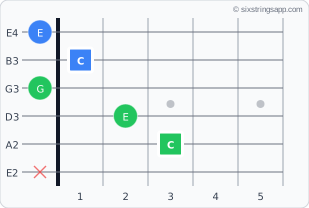
That is why a chord is not the same thing as a finger shape. A chord is a set of notes. A fingering is one way to play those notes on an instrument.
To check this in practice, open Chords, Arpeggios, Scales, choose C major, and switch the display from notes to intervals. This makes it easier to see where 1, 3, and 5 are located in different fingerings.
One set of notes, different ways to play it
A major triad can be played as a chord, as an arpeggio, or as part of a riff.
Take C major:
C–E–GIf you play these notes together, you get a chord:
C + E + GIf you play them one after another, you get an arpeggio:
C → E → G → CIf you repeat the same notes in a rhythm, they can become a riff or a melodic phrase:
C → E → G → EThe musical material is the same: C, E, and G. Only the way of playing changes. This is why the 1–3–5 formula is useful beyond chord shapes. It also helps you find target notes for arpeggios, melodies, and improvisation.
For example, if the accompaniment is playing C major, the notes C, E, and G will feel like stable target notes. They are good places to end phrases, add accents, or build short melodic answers.
Why you should know the 1–3–5 formula
The major triad formula helps you avoid memorizing every fingering as a separate object.
It helps you:
- understand what a major chord contains;
- build chords from any root;
- find arpeggios across the fretboard;
- see which note creates the major sound;
- compare major and minor triads;
- analyze unfamiliar fingerings.
If you know that C major is C, E, and G, it becomes easier to understand why different shapes, with or without barre, can still give you the same chord. They contain the same notes, just arranged differently.
5-minute exercise
- Choose a C major chord.
- Play it as a normal chord.
- Find the notes C, E, and G separately on the first three strings.
- Play them one by one: C → E → G → C.
- Play only C and E.
- Then play C, Eb, and G.
- Compare the feeling of C major and C minor.
The main goal is to hear that a major triad is not tied to one shape. It is three notes that can be placed on the fretboard in different ways. And the major quality depends mostly on the major third.
Common mistakes
Confusing a chord with a fingering. One fingering is only one way to play a chord. C major remains C major as long as the notes C, E, and G are present.
Thinking a triad must always use exactly three strings. On guitar, a triad often sounds on four, five, or six strings. That is normal: some notes are repeated in other octaves.
Calling every major chord “happy”. Major often sounds brighter than minor, but mood does not come from the chord formula alone. Context matters more than the cliché.
Recognizing major only by shape. The same shape can move along the fretboard and produce different chords. It is more reliable to check the content: root, major third, and perfect fifth.
What to study next
- Minor Triad — the next step for comparing the formulas 1–3–5 and 1–♭3–5.
- How Triads Are Built — the general principle behind three-note chords.
- What Is Major in Music — how major works beyond a single chord.
- What Is Fingering on Guitar — how fingering differs from the chord itself.
- What Is a Chord in Music — what a chord is, how it differs from a single note or a fingering, and how chords are built from intervals.
- What Is an Arpeggio — how an arpeggio uses the same notes as a chord, but plays them one by one.
- Chords, Arpeggios, Scales — a tool where you can see the 1–3–5 formula inside fingerings and arpeggios.
Short summary
A major triad is built with the formula 1–3–5. Its major quality comes from the major third, while the perfect fifth adds stability. If a chord contains the root, major third, and perfect fifth, it is a major triad — no matter which fingering you use.