How to memorize notes on the fretboard
Memorizing notes on the fretboard is not about rote learning a large table. It is the skill of quickly answering a simple question: “Where is the note I need right now?”
In the previous article, “How the Guitar Fretboard Works”, we covered the foundation: strings, frets, semitones, octaves, and repeating notes. Now the task is different: turn that logic into a skill.
Knowing the fretboard does not mean instantly naming every note on every fret. At first, a more useful result is enough: you see an area of the fretboard, find the note you need without long counting, and can play a simple phrase, chord, or scale from that note.
The main beginner mistake is trying to learn the whole fretboard at once. It is like trying to memorize a city map by looking at every street at the same time. It is much more useful to walk a small route every day, and then connect those routes together.
What exactly should you memorize?
It is better to learn the fretboard through tasks, not by going string by string from the first string to the last.
You need to be able to:
- quickly find one chosen note in different places;
- name notes in a familiar position;
- see the nearest octave;
- find the root of a chord;
- test yourself without hints;
- use the note you found in a short musical phrase.
If you only look at a fretboard diagram, it may feel like you know the notes. But real knowledge appears only when you can find them with your hands on the instrument.
Start with natural notes
You do not need to learn every sharp and flat right away. Start with natural notes:
C D E F G A BThis is enough to begin navigating the fretboard. Later, sharps and flats become intermediate points between notes you already know.
For example, if you know where F and G are, then F# is between them. If you know A and B, then Bb is between them. This makes memorization easier: you are not learning every cell separately, but seeing connections.
The one-note method
The most useful first exercise is to choose one note and search only for that note.
For example, today you are learning C. Do not try to learn D, F#, Bb, and everything else at the same time. Your task is to find C in several places on the fretboard and remember how those places feel.
Start with C notes that are easier to find:
- 5th string, 3rd fret;
- 6th string, 8th fret;
- 2nd string, 1st fret;
- 1st string, 8th fret.
You do not need to find every possible C right away. Three or four points are enough if you can repeat them confidently tomorrow.
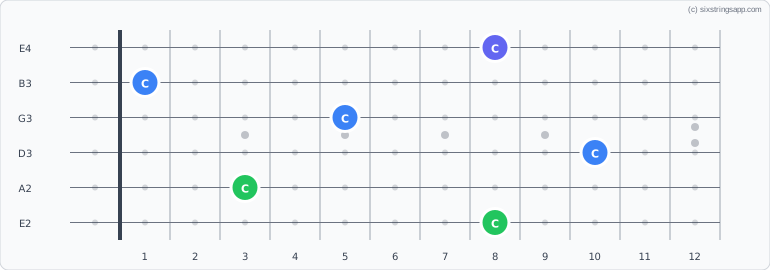
Small example: several C notes on the fretboard
After that, play these C notes in a different order. Then close the diagram and find them again. This is how memory works: not from looking, but from trying to recall.
Test yourself instead of rereading the diagram
Memorization starts when you remove the hint.
A weak method: stare at a full fretboard diagram for a long time and hope the notes will gradually stick.
A better method: look at the diagram for 20 seconds, close it, find the notes on the guitar, then check yourself.
The fretboard explorer is useful for this. Choose one note, see where it is located, then remove the hint and find those places on a real guitar. After that, open the diagram again and check your mistakes.
Mistakes are useful here. If you confused a fret or a string, your brain gets a point to correct. Next time, that place will be easier to remember.
Learn notes in positions
Guitarists rarely think about the entire fretboard at once. Usually, the hand is in some area: around frets 1–4, 5–8, 7–10, and so on.
That is why it is useful to learn notes inside a small position.
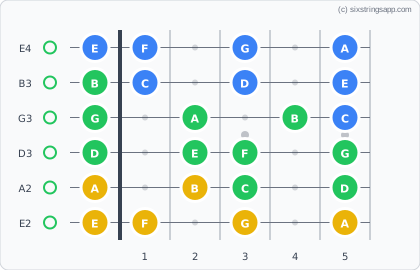
For example, choose the area from the 3rd to the 5th fret. Find all the natural notes there that you can already name. Do not rush. It is better to know a small area confidently than the whole map approximately.
Ask yourself questions:
- what note is on the 3rd fret of the 5th string?
- where is a nearby G?
- where is the nearest C?
- can I play a short phrase using only notes around this area?
This is how notes begin to connect with real playing.
Connect notes with chords
Fretboard notes are easier to remember when you need them for a specific task.
For example, you play a C chord. Find the note C near that fingering. Then find G near the G chord. Then find A near Am.
This helps you understand where chord roots are. That is more important than mechanically naming every note on every fret.
The root helps you navigate chords, riffs, scales, and progressions. If you know where the main note is, it is easier to build everything else around it.
Do not separate notes from sound
There is another common mistake: a person knows that the 3rd fret on the 5th string is C, but does not connect it with the actual sound.
That is why every note you find should be played and named out loud.
Do not just look and think, “this is C.” Play the note, say “C,” and listen to the sound. Then find another C higher, play it, and say the name again.
This connects three things:
- the place on the fretboard;
- the note name;
- the real sound.
Without this connection, knowledge stays as a dry diagram.
7-day plan
To avoid learning everything at once, you can use a short plan.
Day 1: open strings
Name the strings from the sixth to the first and back. Then play each string and say its name.
Day 2: the note C
Find 3–4 C notes on the fretboard. Play them one after another, then find them without hints.
Day 3: the note G
Do the same with G. Compare where C and G are. Try moving between them.
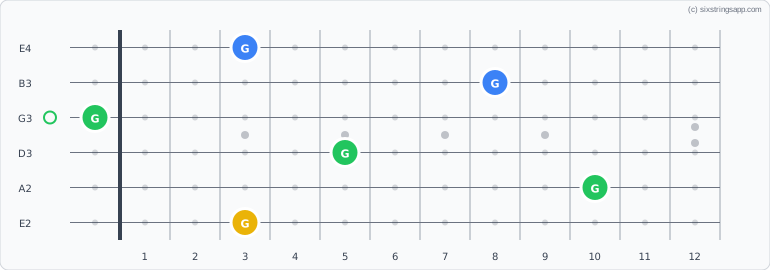
Day 4: the note A
Find A in several places. Then play C, G, and A in a random order.
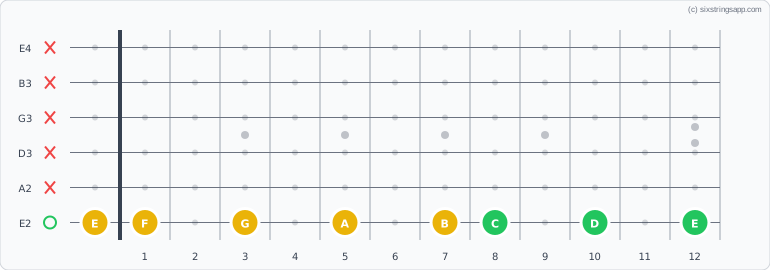
Day 5: the 6th string
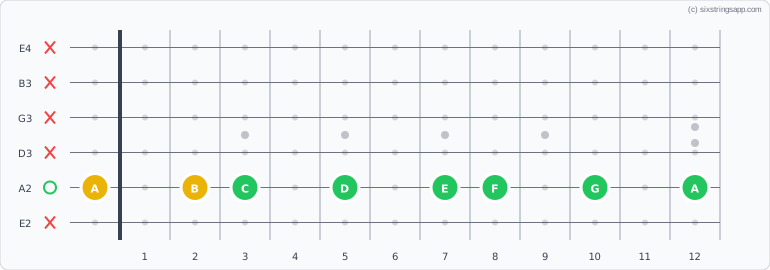
Find E, F, G, A, B, C, and D on the 6th string up to the 12th fret. Do not rush. It is better to name five notes confidently than ten notes with constant mistakes.
Day 6: the 5th string
Repeat the same approach on the 5th string. Pay attention to the notes that familiar chords are built from.
Day 7: test without the diagram
Choose five notes: C, D, E, G, A. Find each one in two places. Then check yourself in the fretboard explorer.
This plan will not make you a fretboard master in one week. But it will give you the main thing: you will begin to recall notes actively, not just recognize them on a picture.
5-minute exercise
- Choose one note, for example C.
- Find it in two places on the fretboard.
- Play each note you found and say its name out loud.
- Close the hints and find the same notes again.
- Check yourself in the fretboard explorer.
- Play a short phrase starting from that note.
The main goal is not to learn the whole fretboard at once, but to learn how to quickly find one needed note and use it in your playing.
Common confusion
Do not start with a full diagram of all notes. A large diagram is useful for checking, but it works poorly as the first memorization method.
Do not learn notes only with your eyes. Play them, say them out loud, and listen. Otherwise, the knowledge will not move into your hands.
Do not try to count from the open string every time. At first, that is normal, but gradually you need reference points: familiar notes, fret markers, octaves, and chord roots.
Do not mix all tasks at once. One day — one note or one small fretboard area. This may look slower, but the progress is more stable.
Sharps and flats should not be ignored forever. Just add them after the main notes stop feeling random.
What to study next
After this topic, it is logical to move to nearby materials:
The main idea: fretboard notes are memorized through active searching. Choose a small task, remove the hint, find the note with your hands, say it out loud, check yourself, and immediately use the sound in a simple musical phrase.