How the guitar fretboard works
The guitar fretboard is a map of sounds. On this map, there are strings, frets, and notes.
A string produces a sound. A fret changes the pitch of that sound. If you press the string on a different fret, you get a different note. This is why you can imagine the fretboard as a grid: the strings run vertically, the frets run horizontally, and every point gives you a specific sound.
On a standard six-string guitar in standard tuning, the open strings are named like this, from the sixth string to the first:
E A D G B EThe sixth string is the thickest and lowest. The first string is the thinnest and highest. Both outer strings are called E, but they are different E notes: one sounds low, the other sounds higher.
If you translate standard tuning into Russian note names, you get:
mi, la, re, sol, si, mi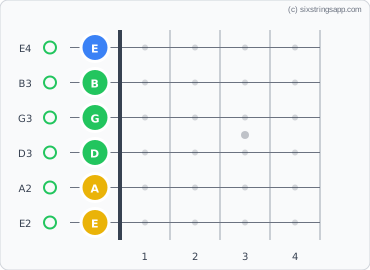
An open string is the sound of a string without any fret pressed. For example, the open sixth string sounds as E. If you press the same string on the first fret, the sound becomes one semitone higher. On the second fret, it becomes one more semitone higher.
The main fretboard rule is simple: on one string, each next fret raises the sound by one semitone.
For example, on the first string, you get this sequence:
| Position | Note |
|---|---|
| open string | E |
| 1st fret | F |
| 2nd fret | F# |
| 3rd fret | G |
| 4th fret | G# |
| 5th fret | A |
This rule helps you stop seeing the fretboard as a set of random points. If you know the open string and understand semitone movement, you can gradually work out the notes on the frets.
Small example on one string
In this example, each next note is on the neighboring fret. That means each step raises the sound by one semitone.
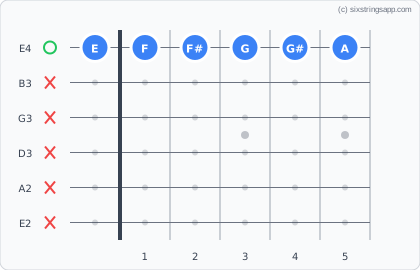
But the fretboard does not work only from left to right. The same note can appear in different places. For example, E can be played on the open first string, the open sixth string, the 12th fret of the first string, and in other positions.
This is not a mistake or unnecessary complexity. It is a feature of the guitar. The same sound, or a related sound in another octave, can be found in different ways. This is why guitar often gives you several fingerings for the same musical idea.
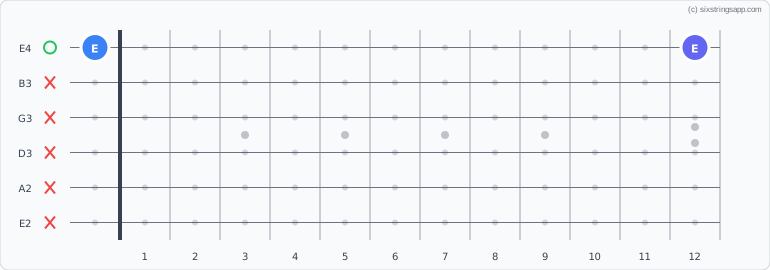
Octaves help you see this logic. If you move along one string, after 12 frets the note repeats with the same name. For example, the open first string is E, and the 12th fret of the first string is also E, only higher.
Small octave example on one string
This makes the fretboard look more logical: notes do not continue forever with new names. They repeat through octaves.
Fretboard landmarks
Most guitar fretboards have position markers on the 3rd, 5th, 7th, 9th, and 12th frets. They are not just decoration. They are quick landmarks that help you avoid counting every fret from the start of the neck.
Beginners often get lost not because they do not know all the notes, but because they do not understand where their hand is. The markers help you connect your hand to a place.
The most useful first landmarks are:
- 3rd fret — the first convenient point for simple riffs and exercises;
- 5th fret — an important learning position and a common reference point for tuning by ear;
- 7th fret — another convenient middle area for exercises;
- 12th fret — the place where open strings repeat one octave higher.
If you do not yet feel comfortable on the fretboard, do not try to see everything at once. Start with the 3rd, 5th, and 12th frets. That is already enough to make the fretboard stop feeling like a long unclear ruler.
Why shapes sometimes shift on the fretboard
Standard guitar tuning is not completely even.
Most neighboring strings have a similar distance: E–A, A–D, D–G, and B–E. But there is a special case between the G and B strings. Because of it, chord, scale, and interval shapes often shift slightly when they cross the B string.
This is one reason the fretboard can feel illogical at first. You may learn a shape on one group of strings, move it higher, and notice that on the B string your finger has to go somewhere else.
This is not your mistake. This is how standard tuning works.
At the beginning, you do not need to analyze this system deeply. It is enough to remember: if a shape “breaks” near the B string, the reason is probably not you, but the tuning.
Why the sixth and fifth strings are especially important
Many guitarists start learning the fretboard from the sixth and fifth strings. This is a good path.
The sixth and fifth strings are convenient places to find chord roots. The root is the main note that gives a chord its name. For example, in a C chord the main note is C, and in a G chord the main note is G.
Many barre chord shapes, power chords, riffs, and simple routes through keys are built from the sixth and fifth strings. That is why knowing the notes on these two strings gives you practical value right away.
If you know where G, A, C, and E are on the sixth string, it becomes easier to find chords, build riffs, and understand why a certain fingering has its name.
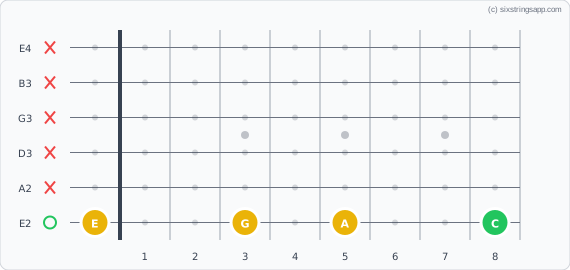
You do not need to start with a full table of every note on the fretboard. It is better to learn the open strings confidently first, then the notes on the sixth and fifth strings, and then expand the map further.
How to learn the fretboard without overload
You do not need to memorize the entire fretboard in one day. That almost always leads to confusion.
It is better to move step by step:
- learn the open string names: E, A, D, G, B, E;
- understand the rule: one fret is one semitone;
- find the first notes on one string;
- learn the main notes on the sixth and fifth strings;
- find repetitions after 12 frets;
- gradually add neighboring strings and octave shapes.
This path only looks slower. In practice, it is faster because you are building a map, not memorizing random points.
You can check this with the fretboard explorer. Choose standard tuning, turn on all notes, and see how the same names repeat on different strings. Then leave only one note, for example C, and find all its repetitions.
For guitarists, this matters for several reasons.
First, knowing the fretboard helps you find the notes you need faster. If you look for C, G, or A not at random, but with an understanding of movement across strings and frets, learning music becomes calmer.
Second, the fretboard helps you see chords. A chord is not just a finger shape. It is a set of sounds. When you know where those sounds are, a fingering stops being a blind diagram.
Third, the fretboard helps you see scales. A scale is a set of notes arranged in a certain order. On guitar, that order becomes shapes, positions, and routes across the strings.
Fourth, knowing the fretboard helps you move ideas. You can play a phrase low, then find similar notes higher and repeat it in another register. This gives riffs, melodies, and solos more options.
5-minute exercise
- Name the open strings from the sixth to the first: E, A, D, G, B, E.
- Choose the first string.
- Play the open string, 1st fret, 2nd fret, 3rd fret, and 4th fret.
- Name the notes: E, F, F#, G, G#.
- Find E on the 12th fret of the first string.
- Compare open E and E on the 12th fret: the name is the same, the pitch is different.
- Find the 3rd, 5th, 7th, and 12th frets by the markers, without counting every fret out loud.
The main goal is to understand the fretboard as a map where every string and every fret gives you a specific sound.
Common confusion
A string and a note are not the same thing. A string is part of the instrument. A note is the name of a sound. One string can produce many different notes on different frets.
A fret is not a finger number. A fret shows a place on the fretboard. For example, “3rd fret” means a position on the fretboard, not the third finger.
The same note names do not always mean the same pitch. E on the sixth string and E on the first string are connected, but they sound in different registers.
A shape can shift when it crosses the B string. This is a feature of standard tuning, not a mistake in the logic.
You do not need to learn the entire fretboard right away. It is better to start with the open strings, then understand semitone movement, then find octave repetitions, and gradually expand the map.
What to study next
After this topic, it is logical to move to nearby materials:
The main idea: the guitar fretboard is not a chaotic set of frets and strings, but a map of repeating notes. If you understand open strings, semitone movement, fretboard landmarks, and octave repetition, navigating the fretboard becomes much easier.