The circle of fifths is one of the most familiar diagrams in music theory. It shows musical keys, sharps, flats, and sometimes chord symbols as well.
Looking at a finished diagram, though, doesn't necessarily explain why the keys appear in that order or what to do with the information.
We'll build the circle of fifths from a single note. Along the way, we'll see where key signatures come from and why some keys are neighbors. Then we'll use the circle for guitar playing, transposing songs, and writing music.
What Is the Circle of Fifths?
The circle of fifths arranges musical keys in a sequence of fifths. Moving clockwise, each new tonic is a perfect fifth above the previous one (allowing for octave displacement). Moving counterclockwise, each new tonic is a perfect fourth above the previous one.
These are the two intervals behind the diagram:
- Perfect fourth: five semitones.
- Perfect fifth: seven semitones.
For example, ascending from C to G gives us a perfect fifth. Ascending from C to F gives us a perfect fourth.
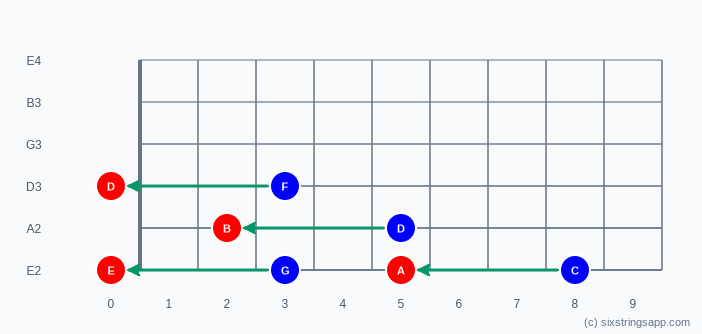
On guitar, you can play C at the third fret of the fifth string and G at the third fret of the sixth string. In that register, moving from C down to G is a descending perfect fourth. Inverting that interval gives us a perfect fifth.
To hear an ascending perfect fifth, play C at the third fret of the fifth string, followed by G at the fifth fret of the fourth string.
These intervals are the foundation of the circle.
Building the Circle of Fifths from Scratch
Start with C.
Move up a perfect fifth and you reach G.
Move up another fifth from G and you reach D.
Keep going:
C → G → D → A → E → B → F♯ → C♯ → G♯ → D♯ → A♯ → E♯ (= F) → B♯ (= C)
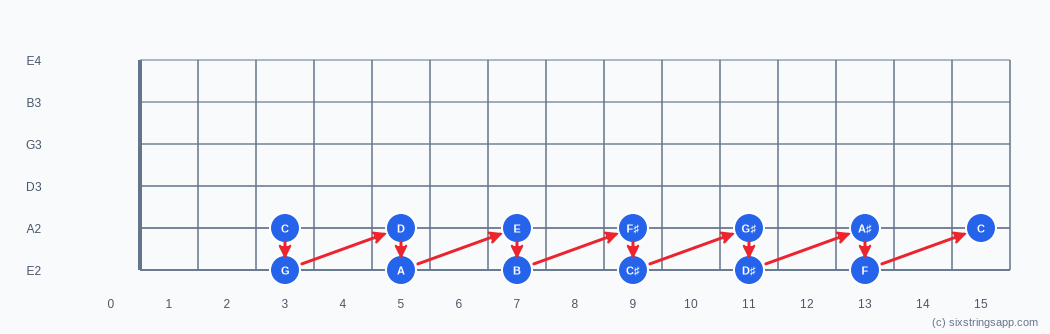
Each step adds seven semitones. For convenience, we can move notes into other octaves. When we do that, the interval between the actual pitches played may no longer be an ascending fifth.
Now put these notes around a circle, with C at the top.
Place G, D, A, and the remaining notes clockwise from C.
That's the basic structure of the circle of fifths.

But why does this sequence eventually return to its starting point, when we can keep stacking fifths indefinitely?
Why the Circle Closes After Twelve Steps
In twelve-tone equal temperament, an octave is divided into twelve equal semitones.
A perfect fifth in this system spans seven semitones.
If we keep adding seven semitones and reduce each result to a single octave, we visit all twelve pitch classes before returning to the starting one.
In numbers:
12 × 7 = 84 semitones = 7 octaves.
So twelve ascending fifths lead to a note enharmonically equivalent to the starting note, seven octaves higher. In our spelling, that's B♯, which sounds the same as C in equal temperament.
There's an interesting detail here.
A justly tuned perfect fifth, based on a 3:2 frequency ratio, is slightly different from an equal-tempered fifth.
If you stack twelve just perfect fifths, they won't line up exactly with seven octaves.
The difference is called the Pythagorean comma—approximately 23.46 cents.
Equal temperament distributes this discrepancy, allowing the twelve pitch classes to form a closed system.
That's why the familiar circle of fifths primarily describes the relationships between notes and keys in the modern twelve-tone system.
Why Moving the Other Way Gives Us Fourths
Now move counterclockwise from C.
You'll get:
C → F → B♭ → E♭ → A♭ → D♭ → G♭ ...

Each next note is a perfect fourth above the previous one.
Why?
A perfect fourth and a perfect fifth are inversions of one another. Together, they add up to an octave:
5 + 7 = 12 semitones.
Moving up a fourth is therefore equivalent to moving down a fifth, after shifting the result into another octave.
This is why the same diagram is also called the circle of fourths.
Clockwise, we read it as a series of ascending fifths; counterclockwise, as a series of ascending fourths.
From Notes to Musical Keys
So far, we've built a sequence of root notes. Now let's see how it relates to keys.
Start with C major.
The C major scale contains seven notes:
C – D – E – F – G – A – B
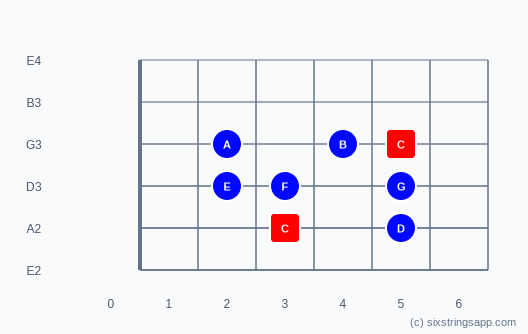
There are no sharps or flats.
Move one position clockwise to G major.
Its scale contains:
G – A – B – C – D – E – F♯
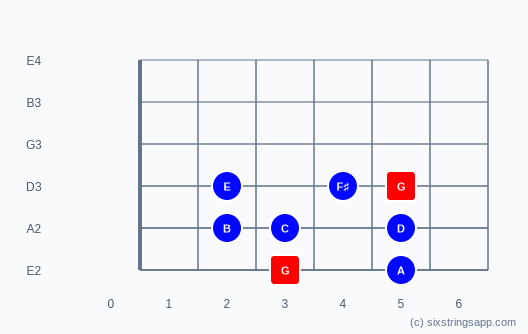
Compared with C major, only one note changes: F becomes F♯.
The next key is D major:
D – E – F♯ – G – A – B – C♯
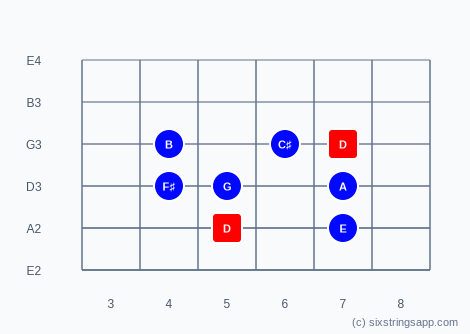
Now we have two sharps: F♯ and C♯.
The next step takes us to A major, adding a third sharp: G♯.
So as we move clockwise, each new major key adds one sharp to the key signature, up to seven sharps.
Moving counterclockwise works in a similar way, but with flats.
F major introduces B♭. B♭ major adds E♭. E♭ major adds A♭.
Table of Keys and Key Signatures
| Number of accidentals | Sharp keys | Flat keys |
|---|---|---|
| 0 | C | C |
| 1 | G — F♯ | F — B♭ |
| 2 | D — F♯, C♯ | B♭ — B♭, E♭ |
| 3 | A — F♯, C♯, G♯ | E♭ — B♭, E♭, A♭ |
| 4 | E | A♭ |
| 5 | B | D♭ |
| 6 | F♯ | G♭ |
| 7 | C♯ | C♭ |
For keys with four or more accidentals, the table lists only the key names. We'll cover the complete order of sharps and flats next.
Why Only One Note Changes Between Neighboring Keys
Consider moving from C major to G major.
F is the fourth scale degree in C major. Raise it by a semitone and it becomes F♯.
In G major, F♯ is the seventh scale degree.
If we move the other way, from C major to F major, B becomes B♭.
B was the seventh scale degree of C major; B♭ becomes the fourth scale degree of F major.
This relationship explains why accidentals appear in a predictable order around the circle.
How to Remember the Order of Sharps and Flats
Sharps always appear in this order:
F♯ – C♯ – G♯ – D♯ – A♯ – E♯ – B♯
Flats appear in the reverse order:
B♭ – E♭ – A♭ – D♭ – G♭ – C♭ – F♭
You can memorize both sequences, but the circle gives you another way to work them out.
Look at the circle itself.

For sharps, start at F and follow the letter names clockwise:
F → C → G → D → A → E → B
For flats, start at B and follow the letter names counterclockwise:
B → E → A → D → G → C → F
These are exactly the sequences we need.
One detail matters: the circle may show some keys under their enharmonic equivalents—different spellings for the same sounding pitches. For example, D♭ major often appears instead of C♯ major.
When using this method to remember accidentals, follow the letter names rather than copying every accidental displayed on the circle.
Why the Circle Has Two Rings: Major and Minor
Most versions of the circle of fifths have two rings.
The outer ring shows major keys, while the inner ring shows minor keys.
For example, A minor sits next to C major, E minor next to G major, and D minor next to F major.
These pairs are called relative keys. They have the same key signature but different tonics.
C major and A natural minor contain the same notes:
C – D – E – F – G – A – B.
But C is the tonic in C major, while A is the tonic in A minor.
That change of tonal center also changes how the harmony behaves.
To find the relative minor of a major key, move down a minor third—three semitones—from the major tonic.
For example:
- C major → A minor;
- G major → E minor;
- D major → B minor;
- F major → D minor.
Don't confuse relative and parallel keys.
Relative keys: C major and A minor share a key signature but have different tonics.
Parallel keys: C major and C minor share a tonic but use different sets of notes.
This distinction will be useful when we look at chords in the natural minor scale.
Finding the Chords of a Key on the Circle of Fifths
Now let's put the circle to practical use.
Suppose we want to write a chord progression in C major.
First, we need to know which chords can be built from the notes of that key.
Take the C major scale and build a triad on each degree by selecting every other scale note.
We get:
| Scale degree | Chord | Quality |
|---|---|---|
| I | C | Major |
| ii | Dm | Minor |
| iii | Em | Minor |
| IV | F | Major |
| V | G | Major |
| vi | Am | Minor |
| vii° | Bdim | Diminished |

The three major triads sit next to each other on the circle:
F – C – G
These are IV, I, and V.
The inner ring shows the three minor triads next to them:
Dm – Am – Em
These represent ii, vi, and iii.
The seventh diatonic triad, Bdim (B diminished), is built on scale degree vii. It's not always displayed on a basic circle; extended versions may show it separately.
So the circle makes it easy to locate the three major and three minor triads of a key. If the diminished chord isn't shown, you'll need to find it separately.
Example: A Chord Progression in C Major
Take these four chords:
C – Am – F – G
Their scale degrees are:
I – vi – IV – V
Let's play the progression on guitar.
All four chords are diatonic to C major, but that doesn't mean a song must use only diatonic chords.
Borrowed chords, secondary dominants, chromatic movement, and other harmonic devices are all available.
The circle shows us the basic diatonic material, not a complete list of what music is allowed to do.
Chords in Natural Minor
Now choose A minor.

It uses the same notes as C major, so the diatonic triads are the same.
Their scale-degree labels, however, change:
| Scale degree | Chord |
|---|---|
| i | Am |
| ii° | Bdim |
| ♭III | C |
| iv | Dm |
| v | Em |
| ♭VI | F |
| ♭VII | G |
Notice the ♭III, ♭VI, and ♭VII labels.
Why are these degrees marked with flats when A minor has no flats in its key signature?
In this notation system, scale degrees are measured against the parallel major scale. It's a common convention, especially in popular music theory. In classical Roman-numeral analysis, you may also see III, VI, and VII without flats.
In A major, the third, sixth, and seventh scale degrees are C♯, F♯, and G♯.
In A natural minor, they're lowered to C, F, and G.
That's where ♭III, ♭VI, and ♭VII come from.
There's another important difference.
In A natural minor, the triad built on the fifth degree is Em, a minor chord.
In A harmonic minor, the seventh degree is raised from G to G♯. That produces E major—or E7 if we add the seventh—as the dominant harmony.
This dominant creates a stronger pull toward Am.
This is why harmony in a minor key often goes beyond the notes of the natural minor scale.
Transposition: Moving a Song to Another Key
Suppose you've found the chords to a song, but it's uncomfortable to sing.
Maybe the melody is too high or too low for your voice.
You can change the key of the entire song. This is called transposition.
When we transpose, every pitch moves by the same interval, preserving the intervals between the notes.
Moving a Progression from G Major to C Major
Take these four chords in G major:
G – D – Em – C
In G major, their scale degrees are:
I – V – vi – IV
Now we want to play the same harmonic progression in C major.
Instead of calculating each new chord separately, we can work with scale degrees.
In C major:
- I — C;
- V — G;
- vi — Am;
- IV — F.
That gives us:
C – G – Am – F
The scale degrees are unchanged: I–V–vi–IV.
The absolute pitches change, but the harmonic relationships remain the same.
If the song has a melody, it must be transposed by the same interval too.
Transposing for Easier Guitar Fingerings
Transposition isn't only useful for singers.
Suppose a beginner guitarist wants to play:
B♭ – E♭ – F – Gm
In B♭ major, these are I–IV–V–vi.
Some familiar guitar voicings for these chords require barre chords.
Let's move the progression to G major:
G – C – D – Em
Now all four chords can be played with open-string shapes.
But the sounding key has changed.
If you need to keep the original pitch, put a capo at the third fret and play the G, C, D, and Em shapes.
You'll hear the original chords: B♭, E♭, F, and Gm.
This makes the progression easier to play without changing the original sounding key.
Of course, the result depends on the instrument, tuning, capo placement, and the actual guitar part. Not every song can be made easier this way.
Closely Related Keys and Modulation
We've seen that neighboring keys on the circle of fifths differ by only one note in their diatonic scales.
That means they share a lot of musical material.
For example, A natural minor contains:
A – B – C – D – E – F – G
E natural minor contains:
E – F♯ – G – A – B – C – D
Only one note changes: F becomes F♯.
As a result, these keys have several chords in common.
Those shared chords can help us move from one key to another.
What Is Modulation?
Modulation is a change of key within a piece of music, where the new tonal center is established clearly enough to be heard as the new home key.
This is different from transposition.
Transposition moves an entire musical passage to a different pitch level.
Modulation happens within the music: a passage begins in one key and then moves to another.
Example: Moving from A Minor to E Minor
First, establish A minor:
Am – Dm – E7 – Am
Now try moving toward E minor using shared chords:
Am – C – G – B7 – Em
Am, C, and G are diatonic chords in both keys.
But B7 contains D♯, which belongs to neither A natural minor nor E natural minor. It's the raised seventh degree of E harmonic minor.
D♯ functions as a leading tone to E, strengthening the B7 → Em resolution.
If the music continues in E minor and reinforces E as the tonic, listeners can hear E minor as the new tonal center.
Here, the circle helps us see how the keys are related and identify shared harmonic material.
It can't tell us by itself whether a particular passage constitutes a full modulation. The melody, harmonic context, duration of the new section, and the way phrases end all matter.
Tonicization: A Temporary Move Toward Another Tonic
A piece can briefly emphasize another tonic without establishing a lasting new key. This is called tonicization.
Let's start with a progression in C major:
C – Am – Dm – G7 – C
This is a diatonic progression that returns to the tonic.
Now replace Am with A7:
C – A7 – Dm – G7 – C
A7 contains C♯, a note outside the C major scale.
But A7 is the dominant seventh chord of Dm.
So A7 → Dm briefly creates a pull toward D minor.
G7 then resolves to C, bringing us back to C major.
We haven't established D minor as the new main key. We can therefore hear this as a short tonicization of the ii chord.
Depending on the context, a brief secondary dominant isn't necessarily enough to establish a new tonal center.
Finding Dominants on the Circle
Suppose we want the dominant chord of Dm.
Find Dm on the minor ring of the circle and move one position clockwise, toward Am.
Take its root, A, and build a dominant seventh chord: A7.
Now we can use this resolution:
A7 → Dm
The same method gives us:
- G7 → C;
- D7 → G;
- E7 → Am;
- B7 → Em.
Remember that the circle shows relationships between root notes. It doesn't automatically construct full chords or specify their quality. To build a dominant seventh chord, you also need to know how chords are stacked in thirds.
How to Use the Circle of Fifths in Practice
We now have several concrete applications.
Find a Key Signature
Choose a key and count the steps from C major.
Clockwise movement adds sharps; counterclockwise movement adds flats, up to seven accidentals in either sequence.
Find the Chords in a Key
Choose the tonic and locate I, IV, and V. Then find the minor triads on ii, iii, and vi, plus the diminished triad on vii°.
For natural minor, use the corresponding set of degrees and chords.
Transpose a Song
Identify the scale degrees of the original progression, choose the destination key, and substitute the chords built on those same degrees.
Find Closely Related Keys
Look at neighboring sections of the circle and compare their scales and shared chords.
This gives you possible routes for a smooth modulation.
Find a Dominant Chord
Move a perfect fifth above the root of your target chord, then build a dominant seventh chord. For example, the dominant seventh of Dm is A7.
Practice Exercises
Exercise 1: Build the Circle Yourself
Take a sheet of paper and write C.
Find each following note a perfect fifth above the previous one.
Continue until you've found all twelve pitch classes.
Arrange the notes around a circle.
Then check your result against the interactive circle of fifths.
Exercise 2: Find Key Signatures
Without looking anything up, work out the key signatures of G major, D major, A major, F major, and B♭ major.
Check your answers on the circle.
Then try naming the sharps and flats in their standard order, starting from the appropriate note on the circle.
Exercise 3: Find the Chords
Choose D major.
Find all seven diatonic triads and label them with Roman numerals.
Then choose its relative minor, B minor, and see how the roles of those same chords change.
Exercise 4: Transpose a Progression
Start with:
G – D – Em – C
Identify the scale degrees.
Now transpose the progression to F major and D major.
Play both versions on guitar and listen to how the pitch level changes while the harmonic structure stays the same.
Exercise 5: Find a Modulation
Choose C major and G major.
Compare their notes and identify the diatonic chords they share.
Try writing a short progression that starts in C major and ends with G major clearly established as the new tonic.
Then try moving back.
Common Mistakes
Confusing a key with a single chord. A progression containing a G major chord isn't necessarily in G major.
Assuming the circle shows every chord you can use. It helps identify the basic diatonic set, but music doesn't stop there.
Confusing relative and parallel keys. C major and A minor are relative keys; C major and C minor are parallel keys.
Treating every chord change as modulation. Modulation requires a new tonal center to be established. Simply playing a chord found in another key isn't enough.
Assuming closely related keys always sound better than distant ones. Shared material makes them easier to connect, but the musical result depends on the context.
Letting the diagram replace your ears. The circle shows possible relationships and helps analyze harmony. You still need to listen to the result.
Interactive Circle of Fifths
You can practice with the Circle of Fifths tool on Six Strings App.
Choose a major or minor key and look at how its chords and scale degrees are arranged.
Try the exercises from this article, then pick another key and see whether you can identify its chords before checking the diagram.
You can also use the Harmony tools to explore chord progressions and their functions.
What to Learn Next
After learning the circle of fifths, it makes sense to explore how triads are built, how chords function in a key, how cadences work, and how modulation connects different tonal centers.
If you're writing songs, try analyzing your own chord progressions. Identify the scale degrees, locate the dominants, and experiment with moving from one key to another.
In Short
The circle of fifths is a diagram built from sequences of perfect fifths and fourths.
Its structure is connected to the twelve-tone system, the construction of major and minor scales, and the predictable order of accidentals in key signatures.
In practice, it helps us find the chords of a key, transpose progressions, recognize closely related keys, and explore harmonic movement.
But the circle can't replace an understanding of harmony or a trained ear.
It becomes much more useful when each point on the diagram represents a note, key, or chord that we can actually play and hear.