Chord vs Fingering: What's the Difference
C major can be played as an open shape near the nut, as a barre chord higher up the neck, or as a smaller shape on just a few strings. In all these cases, it can still be the same chord — C. But your fingers will be in different places, and the sound may be higher, denser, or more open.
This is where guitarists often get confused: we memorise “the C chord” as one picture on the fretboard. In reality, that picture shows only one way to play the chord. In this article, we will separate the chord from the fingering and see why this makes the fretboard easier to understand.
Short Answer
A chord is a group of notes with a specific structure. A fingering is a way to play those notes on an instrument.
For example, a C major chord consists of these notes:
C  E  G
1  3  5
You can find these notes in different places on the fretboard and play them with different fingerings. As long as the sound keeps the core of C major — C, E, and G — you are dealing with different versions of the same chord.
What Is a Chord?
A chord is several notes that are heard as one combined sound.
In its basic form, a major triad contains three different notes:
- the root —
1; - the major third —
3; - the fifth —
5.
For C major, that means:
C + E + G
1   3   5
These intervals are what make the chord major. Whether you play them on open strings, as a barre chord, or higher up the neck, the chord name does not change as long as its structure and basic meaning stay the same.
Read more about this in “What Is a Chord in Music?” and “How Triads Are Built”.
What Is a Fingering?
A fingering is the placement of the fingers that a musician uses to play notes on an instrument.
For guitarists, a fingering shows:
- which strings to press;
- which frets the fingers are placed on;
- which strings ring open;
- which strings need to be muted;
- whether the shape is comfortable in a given position.
An open C chord is often written like this:
x32010Here is what that means:
- the sixth string does not sound —
x; - the fifth string is fretted at the 3rd fret — note
C; - the fourth string is fretted at the 2nd fret — note
E; - the third string is open — note
G; - the second string is fretted at the 1st fret — note
C; - the first string is open — note
E.
So the result is:
Notes:    C  E  G  C  E
Degrees:  1  3  5  1  3
The notes C and E are repeated in different octaves, but the chord is still C major.
One Chord, Several Fingerings
On guitar, the same chord can often be played in many places on the fretboard.
Take three fingerings of C major:
| Version | Shape | Notes that sound | What stays the same |
|---|---|---|---|
| Open C | x32010 | C, E, G, C, E | C major chord |
| C as an A-shape barre | x35553 | C, G, C, E, G | C major chord |
| C as an E-shape barre | 8 10 10 9 8 8 | C, G, C, E, G, C | C major chord |
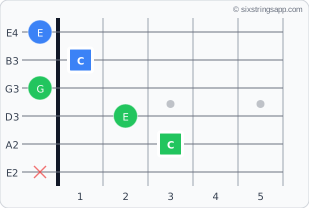
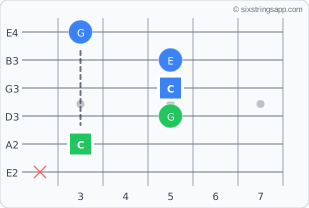
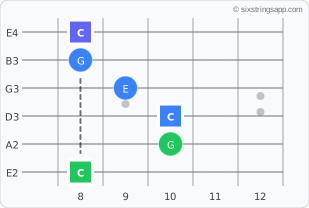
All three versions contain the notes C, E, and G. That is why the chord name stays the same. But the shapes do not sound identical:
- open C rings brightly because it uses open strings;
- the
x35553shape sounds more compact and sits higher in register; - the shape at the 8th fret sounds even higher and may fit better as a second-guitar part.
Knowing one shape answers the question “Where do I put my fingers?” Knowing several fingerings answers a more musical question: “Where, and with what sound, should I play this chord?”
Between the Chord and the Fingering, There Is Another Layer: Voicing
Two fingerings of the same chord can contain the same main notes, but distribute them differently.
For example:
x32010     C  E  G  C  E
x35553     C  G  C  E  G
Both are C major. But in the second shape, the note order is different: after the low C, you hear G, not E. The repeated notes and the highest note also change.
This distribution of notes inside a chord is often called a voicing. You do not have to memorise this term right away. The main idea is enough:
A chord answers the question “Which notes create the harmony?” A fingering answers the question “How can I play one version of that harmony on guitar?”
One Shape Does Not Always Mean One Chord
The reverse can also happen: the finger pattern may stay the same, while the chord name changes.
For example, an E-shape barre chord can move along the fretboard:
| Shape position | Lowest note | Chord |
|---|---|---|
Open shape 022100 | E | E major |
Barre at the 1st fret 133211 | F | F major |
Barre at the 3rd fret 355433 | G | G major |
The fingers follow the same logic, but the whole shape moves up. Every note becomes higher, the root changes, and a new chord appears.
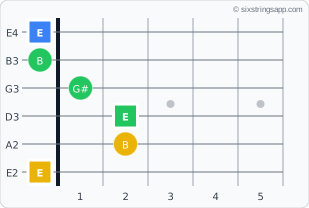
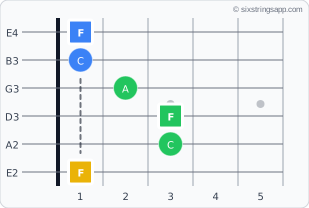
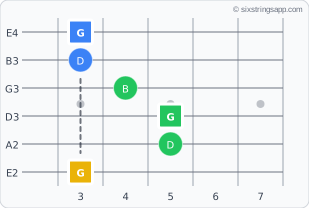
This is one reason it is useful to look not only at the shape, but also at the notes or intervals inside it.
What Changes When a Different Note Is in the Bass?
In the simple C major shape, the lowest sounding note is usually C:
x32010 = C in the bassBut you can also let the open sixth string E sound:
032010 = E in the bassThe notes of C major are still there: C, E, and G. But the lowest note is now E. This version is usually written as:
C/EIt is still C major harmony, but with a different note in the bass. It sounds different and can connect more smoothly to nearby chords.
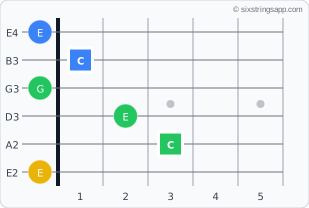
For now, it is enough to remember this: a new fingering does not always completely change the chord name, but the bass note can clarify the notation and change the character of the sound.
Why Guitarists Need to Separate Chords from Fingerings
To Avoid Learning the Fretboard as a Set of Pictures
If you know C only as x32010, the chord seems to disappear beyond the first few frets. If you understand it as the notes C, E, and G, you can find C major in different positions.
To Choose a Convenient Shape in a Progression
In a chord progression, it is not always comfortable to jump from open chords to distant barre shapes. Sometimes nearby fingerings let you play all chords in one area of the fretboard and make the transitions smoother.
To Control the Sound of an Arrangement
An open shape, a dense barre chord, and a small voicing on the top strings may all be the same chord, but they can occupy different places in an arrangement. One version may work for solo accompaniment; another may work better above bass and a second guitar.
To Understand Unfamiliar Shapes
If you see a new finger placement, you do not have to memorise it as a separate object. You can check which notes sound, identify the intervals, and understand what chord it is.
How to Hear the Difference
Take two C major shapes:
x32010
x35553- Play the open C major shape and listen to how the open strings ring.
- Play the
x35553shape with a barre at the 3rd fret. - Compare them: the C major feeling stays, but the timbre and register change.
- Play both shapes one after another in the same rhythm.
- Decide which one would fit a quiet verse better, and which one would fit a denser part.
The main point: the chord keeps its harmonic function, but the fingering affects register, density, and character.
How to See the Difference in Six Strings App
In Chords, Arpeggios, and Scales
Open Chords, Arpeggios, and Scales.
- Choose C as the root and major as the chord type.
- Look at several suggested fingerings.
- Turn on interval display for each shape.
- Check that the shapes contain the degrees
1,3, and5. - Compare which strings and positions these degrees appear on.
This shows that the app is not showing different “C chords.” It is showing different ways to play C major harmony.
In Chord Identifier
Open Chord Identifier.
- Mark the notes of the
x32010shape on the fretboard. - See which name the tool suggests.
- Clear the shape and mark
x35553. - Compare the result: the fingerings are different, but C major should appear among the options for both shapes.
- Then move the
x35553shape two frets higher and check which chord you get.
This gives you both sides of the topic: one chord can have many fingerings, and one movable shape can be used for different chords.
5-Minute Exercise
- Open C major in Chords, Arpeggios, and Scales.
- Find the open shape
x32010and the barre shapex35553. - Turn on interval display for both shapes and find
1,3, and5. - Play or listen to both fingerings.
- Write one sentence describing how they sound different: for example, “the open shape rings brighter” or “the barre shape sounds higher and denser.”
- Go to Chord Identifier and enter both shapes one by one.
- Move the barre shape two frets higher and identify the new chord.
Main goal: stop treating a chord as one picture and start seeing a fingering as a way to play specific notes.
Common Mistakes
“The C chord is only the x32010 shape.” No. That is one fingering of C major. The same chord can be played higher up the fretboard.
“If the fingers are placed differently, it is a different chord.” Not necessarily. If the main notes keep the structure C, E, and G, it can be another version of C major.
“If the shape looks similar, the chord name stays the same.” Not necessarily. A movable barre shape keeps the same finger pattern, but when it shifts, the root changes and so does the chord name.
“All fingerings of one chord sound the same.” No. Register, open strings, repeated notes, and the bass all affect the colour and density of the sound.
“I need to learn all shapes right away.” No. Start with two shapes of one chord and learn to see the same intervals inside them.
What to Learn Next
- “What Is a Chord in Music?” — to reinforce chord tones and the intervals
1,3, and5. - “What Is Fingering on Guitar?” — to understand finger placement and chord-shape notation in more detail.
- “What Is an Arpeggio in Music?” — to hear chord tones separately.
- “What Is a Chord Inversion” — to understand what happens when the bass note changes.
In short
A chord is the notes and intervals that create harmony. A fingering is a way to play those notes on guitar.
C major is not limited to the x32010 shape: it can be played in different places on the fretboard, with different strings and a different sound. When you see the notes C, E, G and the intervals 1, 3, 5 behind the shape, the fretboard stops being a set of random pictures.