What are simple intervals?
An interval is the distance between two sounds.
Simple intervals are intervals within one octave: from two identical notes at the same pitch to the same note repeated higher or lower.
The word “simple” does not mean that these intervals are always easy to hear. It only describes their range: a simple interval is no wider than an octave.
For example, if you start from C and move upwards through the notes, you get these intervals:
C  D  E  F  G  A  B  C
1  2  3  4  5  6  7  8
From C to the same C is a unison. From C to D is a second. From C to E is a third. From C to the higher C is an octave.
Why musicians need intervals
Intervals help you describe relationships between notes, not only individual note names.
If you only see note names, C–E and G–B look like two different pairs. Once you understand intervals, you can see that both pairs form a third.
This helps you:
- understand how scales and chords are built;
- analyze how melodies move up and down;
- hear stability and tension between notes;
- find the notes you need in different areas of the fretboard;
- move a phrase to a different starting note;
- gradually develop your ear.
Intervals are especially useful for guitar players: the same interval shape can appear from different notes and in different positions on the fretboard.
How to count an interval
Intervals are counted by note names, including both the first and the last note.
For example, from C to E:
C D E
1 2 3
There are three note steps, so this interval is a third.
From C to G:
C D E F G
1 2 3 4 5
There are five note steps, so this interval is a fifth.
From A to C:
A B C
1 2 3
This is also a third, even though it uses different notes.
Important: the interval number is not the number of frets or the number of semitones. The number shows how many note names the interval spans.
Simple intervals from unison to octave
Let us use C as the reference note and build intervals upwards within the C major scale.
| Name | Number | Notes from C | A simple starting impression |
|---|---|---|---|
| Unison | 1 | C–C | the same pitch |
| Second | 2 | C–D | a neighboring step, close movement |
| Third | 3 | C–E | the basis of major or minor character |
| Fourth | 4 | C–F | wider movement, open sound |
| Fifth | 5 | C–G | stable, broad support |
| Sixth | 6 | C–A | wide, melodic movement |
| Seventh | 7 | C–B | strong tension close to the octave |
| Octave | 8 | C–C | the same note at a different pitch height |
The examples in this table use the notes of C major. This means that C–D is a major second, C–E is a major third, C–F is a perfect fourth, C–G is a perfect fifth, C–A is a major sixth, and C–B is a major seventh.
For now, it is enough to remember the number names. The difference between major, minor, and perfect intervals is a useful next step.
Unison and octave: the same note name at different heights
Unison and octave are both connected with the same note name.
A unison means two sounds at the same pitch:
C → C
1
An octave means moving to a note with the same name, but higher or lower:
C → C
1   8
To the ear, an octave feels like returning to the same note in a different register. An adult and a child may sing the same melody an octave apart: the notes feel equivalent in their role, but one voice sounds higher than the other.
On guitar, octaves help you navigate the fretboard. Once you find a C on one string, you can learn to quickly find other C notes higher or lower on the neck.
Second: stepwise movement
A second is the distance to the neighboring scale degree.
C → D
1   2
Seconds are often heard in melodies as a step upwards or downwards. A melody that moves smoothly usually contains many seconds.
A second can sound gentle or tense depending on its exact semitone distance and its context. At this stage, the important thing is to hear the character of a close step.
Third: the character of a chord
A third spans three note names:
C D E
1 2 3

C → E
Thirds are especially important in chords. In a triad, the third helps distinguish a major sound from a minor one:
C major: C E  G
C minor: C Eb G
Both chords start from C and contain G. The difference is in the third: E in the major chord and Eb in the minor chord.
Once you begin to hear thirds, it becomes easier to understand the character of chords.
Fourth and fifth: open intervals of support
A fourth from C is C–F:
C D E F
1 2 3 4
A fifth from C is C–G:
C D E F G
1 2 3 4 5
Fourths and fifths often sound broad and open. The fifth is especially familiar to guitar players from power chords:
C5: C G
    1 5
A power chord does not contain a third, so it does not sound clearly major or minor. Its foundation is the root and the fifth.
Sixth and seventh: a wide leap and tension
A sixth from C to A spans six scale degrees:
C D E F G A
1 2 3 4 5 6
A sixth sounds wide and often appears in melodies as an expressive leap.
A seventh from C to B is very close to the octave:
C D E F G A B C
1 2 3 4 5 6 7 8
The note B nearly reaches the upper C, so the movement B → C is often heard as a strong resolution.
C → B → C
1   7   8
This helps explain why a seventh often creates tension, while the octave feels more stable.
An interval name and its exact quality
A name such as “third” or “second” does not describe an interval completely.
For example:
C → E  = major third
C → Eb = minor third
Both pairs are thirds because they span three note names: C–D–E. But they contain different numbers of semitones, so they sound different.
At the beginning, it helps to separate two tasks:
- Learn to count the interval number: second, third, fourth, fifth, and so on.
- Then learn which intervals can be major, minor, or perfect.
This reduces the risk of confusing an interval's number with its exact distance in semitones.
Melodic and harmonic intervals
The two notes of an interval can be played in different ways.
If the notes are played one after the other, the interval is melodic:
C → EIf the notes sound at the same time, the interval is harmonic:
C + EThese are different listening tasks. In a melodic interval, you hear movement. In a harmonic interval, you hear a sonority.
At first, it is useful to practise both: play the notes one after the other, then play them together when the fingering makes that comfortable.
Intervals on the guitar fretboard
On guitar, the same interval can be found in different places.
For example, from the note C, you can find G as a fifth:
- on the same string by moving along the frets;
- on a neighboring string in a comfortable position;
- higher on the neck in another octave.
In every case, the musical meaning stays the same: G remains a fifth relative to C, even when the fingering and timbre change.
At first, it is useful to see intervals from one reference note:
From C:
D = 2
E = 3
F = 4
G = 5
A = 6
B = 7
C = 8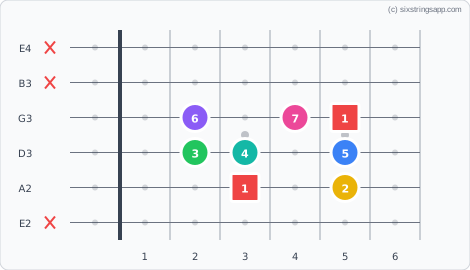
Do not try to memorize the whole fretboard at once. First find a few intervals from one note in one area of the neck, then move the same logic to another position.
How to practise simple intervals
Start from one reference note, for example C.
- Play C and the upper C — an octave.
- Play C and G — a fifth.
- Play C and F — a fourth.
- Play C and E — a third.
- Play C and D — a second.
- Play each interval melodically first, then harmonically if it is comfortable on guitar.
- After that, choose another reference note, such as G, and try to find the same intervals from it.
It is convenient to begin with the octave, fifth, and fourth because their contrast is often easier to hear. Then you can add thirds, seconds, sixths, and sevenths.
The main goal is to connect three things:
- the name of the interval;
- its sound;
- its position on the fretboard.
A 5-minute exercise
Choose C as your reference note.
- For one minute, play C → C and say: “octave.”
- For one minute, play C → G and say: “fifth.”
- For one minute, alternate C → F and C → G: “fourth,” “fifth.”
- For one minute, alternate C → E and C → D: “third,” “second.”
- For the last minute, choose one new reference note and find its fourth, fifth, and octave.
Do not try to play quickly. Listen to the distance between the notes and check yourself on the fretboard.
Common mistakes
- Counting intervals by frets instead of note names. A third is defined by the number of letter names it spans, not only by the number of frets.
- Confusing an interval name with its exact distance. A third can be major or minor; first identify the number, then identify its quality.
- Learning intervals only visually. A table helps you navigate, but an interval must also be heard and played.
- Looking for intervals in only one shape. On guitar, the same interval appears in different positions.
- Trying to learn all intervals at once. It is better to begin with a few clearly contrasting sounds and gradually expand the set.
- Thinking that an interval is only two notes played in sequence. Intervals can be heard both successively and simultaneously.
FAQ
Why can the same interval be found in different places on the fretboard?
Because the guitar repeats the same notes and the same relationships between notes in different positions. C–G remains a fifth no matter where you play those notes.
Why can a third be major or minor?
The word “third” tells you that the interval spans three note names. The words “major” and “minor” specify the distance in semitones. That is why C–E and C–Eb are both thirds, but sound different.
Which intervals should I start with for ear training?
Start with the octave, fifth, and fourth: their contrast is often easier to hear. Then add major and minor thirds, and later seconds, sixths, and sevenths.
Do I need to memorize the number of semitones straight away?
Not necessarily. First learn to count interval numbers and recognize their general character. A semitone table becomes more useful at the next stage, when you begin distinguishing major, minor, and perfect intervals.
What to learn next
- “What Is an Interval in Music”;
- “What Is an Octave”;
- “How Triads Are Built”;
- “Major, Minor, and Perfect Intervals”.
In short
Simple intervals are distances between two notes within one octave: unison, second, third, fourth, fifth, sixth, seventh, and octave.
They are counted by note names, including the starting and ending note. A third spans three note names, a fifth spans five, and an octave spans eight.
When you connect an interval name with its sound and its position on the fretboard, it becomes easier to understand melodies, chords, scales, and your own guitar playing.